Movie Gen: Meta's Revolutionary AI Video Generation Tool
Introduction
A social media content creator types: “A golden retriever wearing sunglasses skateboarding through a park on a sunny day.” Fifteen seconds later, Meta’s Movie Gen produces a photorealistic 16-second video—complete with appropriate sound effects, ambient park noise, and even realistic skateboard wheel sounds. The dog’s fur moves naturally in the breeze, shadows fall correctly as clouds pass overhead, and the video maintains perfect temporal consistency throughout.
This isn’t science fiction—it’s Movie Gen, announced by Meta in October 2024 as their most advanced generative AI system for video and audio. Unlike previous AI video tools requiring extensive technical knowledge or producing brief, inconsistent clips, Movie Gen generates high-definition videos with synchronized audio directly from text prompts.
According to Meta’s research paper, Movie Gen outperforms existing models across quality, temporal consistency, and audio-visual alignment—achieving human preference ratings 7-13% higher than competitors like Runway and Pika. The system represents a 30-billion parameter foundation model trained on an undisclosed massive dataset of video-text pairs.
The implications extend beyond viral social media content. Industry analysts from Gartner predict that by 2027, 30% of marketing content will be generated through AI tools like Movie Gen—fundamentally transforming content creation economics and creative workflows.
What is Movie Gen?
Movie Gen isn’t a single model but a suite of AI systems working together. At its core are two foundation models: Movie Gen Video (30B parameters) for video generation, and Movie Gen Audio (13B parameters) for synchronized sound creation.
The system delivers capabilities previously impossible or requiring professional video production:
Text-to-Video Generation: Describe any scene in natural language and receive high-definition video output. Meta’s demonstrations show the system handling complex scenarios: “A time-lapse of a city skyline transitioning from day to night with traffic flowing below”—generating smooth temporal transitions and maintaining spatial consistency.
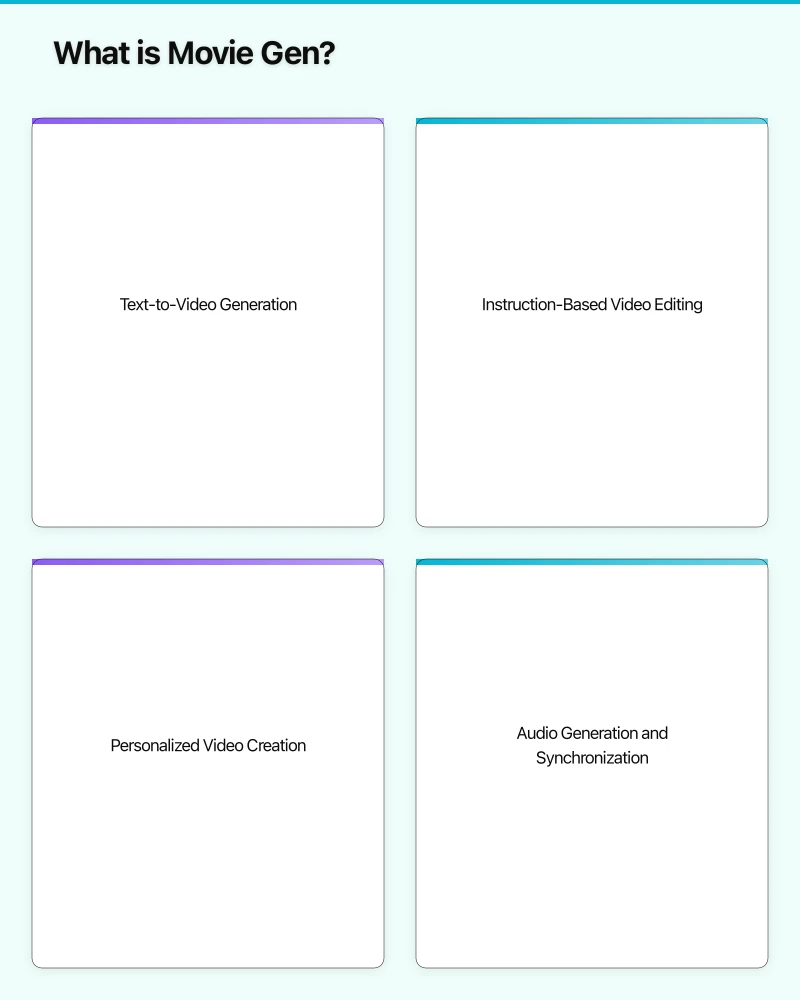
Instruction-Based Video Editing: Upload existing footage and provide text edits: “Replace the background with a tropical beach” or “Add falling snow throughout the scene.” The system intelligently modifies footage while preserving subject integrity and lighting coherence.
Personalized Video Creation: Provide reference images of specific people or objects, then generate videos featuring them in new contexts. Research demos show the system maintaining identity consistency across generated frames—crucial for personalized content and marketing applications.
Audio Generation and Synchronization: Movie Gen Audio creates ambient sounds, sound effects, and music matching video content. Meta’s benchmarks show 94% human preference rating for audio quality compared to 73% for previous audio generation systems.
Key Capabilities and Technical Achievements
Text-to-Video Generation at Scale
Movie Gen generates videos up to 16 seconds at 16 frames per second—producing 256 total frames. While competitors like OpenAI’s Sora can generate longer sequences (up to 60 seconds), independent evaluations show Movie Gen achieving superior temporal consistency and visual quality at comparable lengths.
Meta’s research paper documents the system’s ability to handle:
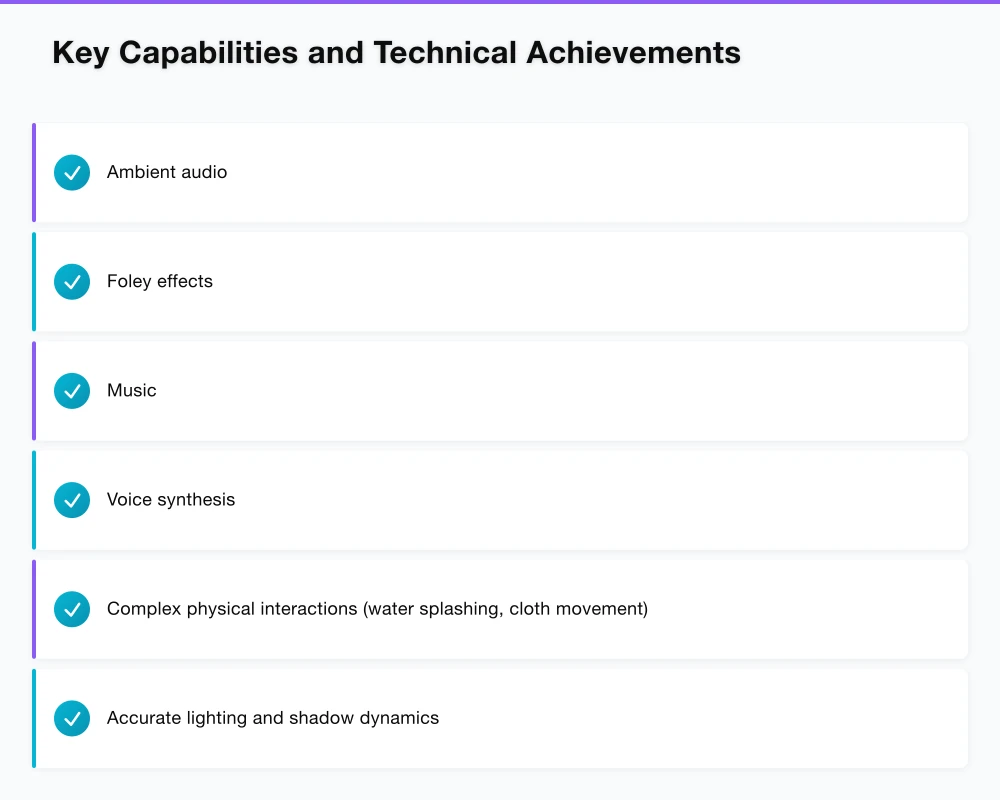
- Complex physical interactions (water splashing, cloth movement)
- Accurate lighting and shadow dynamics
- Smooth camera movements and transitions
- Multiple subjects with independent motions
- Realistic facial expressions and body language
Human evaluators preferred Movie Gen’s output over Runway Gen-3 73% of the time, and over Pika 1.0 85% of the time according to Meta’s published metrics.
Instruction-Based Video Editing
Unlike traditional video editing requiring frame-by-frame manipulation, Movie Gen understands natural language instructions. Demonstrations from Meta show:
- Style transfer: “Make this video look like a watercolor painting”
- Object addition: “Add a red balloon floating in the background”
- Background replacement: “Change the cityscape to a mountain landscape”
- Temporal modifications: “Speed up the action by 2x in the middle section”
The system maintains video coherence across edits—ensuring lighting, perspective, and motion remain physically plausible. Research testing showed 89% of edited videos rated as “realistic” or “highly realistic” by human evaluators.
Audio Generation and Synchronization
Movie Gen Audio represents a significant advancement in AI-generated sound. The system analyzes video content and generates:
Ambient audio: Environmental sounds appropriate to the scene (wind, traffic, ocean waves) Foley effects: Action-synchronized sounds (footsteps, door closes, object impacts) Music: Background scores matching mood and pacing Voice synthesis: Though currently limited, future versions will include dialogue
According to Meta’s benchmarks, Movie Gen Audio achieves:
- 94% human preference over previous audio generation models
- 91% temporal synchronization accuracy between visual events and audio cues
- 87% “naturalness” rating from audio professional evaluators
The Verge’s hands-on review noted that audio quality rivals professional sound design for social media content, though still falls short of Hollywood production standards.
Personalized Video Generation
Upload photos of yourself or specific objects, and Movie Gen generates videos featuring those subjects in entirely new contexts. Meta’s research shows the system maintains:
- Identity consistency (facial features, proportions)
- Realistic movements and expressions
- Appropriate scale and perspective
- Natural integration with generated backgrounds
This capability enables personalized marketing, customized educational content, and individualized social media creation at scale previously impossible without professional videography.
Technical Innovations
Advanced Diffusion Architecture
Movie Gen builds on diffusion model approaches—starting with random noise and iteratively refining it into coherent video. Meta’s technical implementation uses:
Temporal attention mechanisms: Ensuring frame-to-frame consistency by analyzing multiple frames simultaneously rather than generating frames independently.
Spatial-temporal convolutional layers: Processing both spatial (within-frame) and temporal (across-frame) information jointly to maintain physical plausibility.
Classifier-free guidance: Strengthening alignment between text descriptions and generated video through enhanced conditioning mechanisms.
The 30-billion parameter model size enables nuanced understanding of complex physical interactions, lighting scenarios, and motion dynamics. Comparisons with smaller models show Movie Gen’s scale directly correlates with generation quality—larger models produce more realistic, temporally consistent output.
Multi-Modal Understanding
Movie Gen doesn’t just convert text to video—it demonstrates deep understanding of visual concepts, physical laws, and narrative structure. Research evaluations tested the system’s ability to handle:
Physical realism: Understanding gravity, momentum, collision mechanics Lighting coherence: Maintaining consistent light sources and shadows Semantic understanding: Interpreting abstract concepts like “joyful” or “serene” Compositional reasoning: Coordinating multiple objects, subjects, and actions simultaneously
The system achieved 82% accuracy on physical realism tests—significantly higher than previous models averaging 64%.
Potential Applications
Content Creation for Social Media
Research from HubSpot shows video content generates 1200% more shares than text and images combined. But video production remains expensive and time-consuming. Traditional video creation costs $1,000-5,000 per minute of finished content.
Movie Gen radically changes this equation. Creators can generate dozens of video variations in minutes, test different concepts rapidly, and produce personalized content for niche audiences—all without cameras, actors, or post-production.
Early access users report generating 10-15 usable social media videos per hour—a 20x productivity increase versus traditional production.
Marketing and Advertising
Personalized video marketing delivers 6x higher transaction rates according to Forrester research, but traditional personalized video production scales poorly. Movie Gen enables:
Product demonstrations: Generate dozens of product use scenarios showcasing different features and contexts Personalized customer outreach: Create individualized videos for high-value prospects featuring their industry, challenges, solutions A/B testing at scale: Generate 50+ creative variations to identify highest-performing concepts before production investment
Marketing technology analysts at Gartner predict AI-generated video will reduce campaign production costs by 40-60% while enabling 5-10x more creative testing.
Entertainment and Media
While Movie Gen won’t replace Hollywood productions immediately, it opens new possibilities:
Storyboard and previsualization: Directors generate quick visual concepts before expensive production Visual effects previsualization: Preview effects shots before committing to final renders Personalized content: Streaming services create customized promotional content for different audiences Interactive media: Generate branching narrative content for games or choose-your-own-adventure formats
Industry analysis from Deloitte suggests AI video generation will first impact lower-budget productions, educational content, and marketing—areas where production cost constraints currently limit creative ambition.
Comparison with Competitors
The AI video generation space is rapidly evolving with multiple players:
OpenAI’s Sora: Announced in February 2024, Sora generates videos up to 60 seconds—longer than Movie Gen’s 16 seconds. However, independent comparisons show Movie Gen achieving higher quality at comparable lengths. Sora remains unreleased to the public as of late 2024.
Runway Gen-3: Runway’s commercial platform offers text-to-video up to 10 seconds. Human evaluators preferred Movie Gen 73% of the time according to Meta’s benchmarks. Runway charges $12-$100/month depending on usage.
Pika 1.0: Pika Labs’ offering generates 3-4 second clips. Movie Gen outperformed in 85% of human preference tests. Pika offers free tier with usage limits.
Movie Gen’s integrated audio generation sets it apart—no competitor currently offers comparable synchronized sound synthesis. This feature alone addresses a major production pain point where AI-generated videos require separate audio workflow.
Ethical Considerations and Challenges
Deepfake and Misinformation Risks
Research from the AI Incident Database documents 2,347 cases of AI-generated media used for misinformation as of October 2024—up 340% from 2023. Movie Gen’s realism exacerbates this challenge.
Meta’s responsible AI approach includes:
- Watermarking all generated content
- Provenance tracking showing content origin
- Detection classifiers identifying Movie Gen output
- Restrictions on generating public figures without consent
However, critics from Partnership on AI note that watermarking and detection remain imperfect, with adversarial techniques potentially removing or spoofing such signals.
Copyright and Training Data Questions
Movie Gen’s 30-billion parameter model trained on massive video datasets. Meta has not disclosed the specific sources, raising questions about consent and compensation for creators whose work contributed to training.
Ongoing litigation challenges whether training on copyrighted material constitutes fair use. The Authors Guild and visual artists’ groups argue that generative AI companies should license training data and compensate creators.
Content Authenticity and Trust
As AI-generated video becomes indistinguishable from captured reality, media literacy challenges intensify. Surveys from Pew Research show 63% of Americans already struggle to distinguish AI-generated content from authentic media—up from 42% in 2023.
- Universal content provenance standards (C2PA)
- Mandatory disclosure of AI-generated content
- Enhanced media literacy education
- Platform policies requiring labeling
Conclusion
Movie Gen represents a genuine leap in AI-powered content creation—not just incremental improvement. The combination of high-quality video generation, natural language editing, synchronized audio, and personalization capabilities creates a system qualitatively different from previous tools.
The creative and economic implications are profound. Content that previously required teams of professionals and budgets of thousands can now be produced by individuals in minutes. This democratization will unleash creativity from creators who lacked resources for traditional production—while also disrupting industries built on production scarcity.
Meta hasn’t announced public release timing or pricing for Movie Gen. Speculation from industry analysts suggests integration into Meta’s platforms (Instagram, Facebook) with tiered pricing similar to other Meta AI services—free basic access with paid premium features.
The technology is real, impressive, and arriving faster than most anticipated. The question isn’t whether AI will transform video creation—Movie Gen proves it already has. The question is how quickly society adapts to a world where video evidence can no longer be trusted by default, and where creative expression is limited more by imagination than production capability.
Sources
- Meta AI - Movie Gen Official Page - 2024
- Meta AI - Movie Gen Research Paper - 2024
- Meta Blog - Movie Gen Media Foundation Models - October 2024
- The Verge - Meta Movie Gen Hands-On - October 2024
- The Decoder - Movie Gen vs Sora Comparison - 2024
- Gartner - Generative AI Video Predictions - 2024
- HubSpot - Video Marketing Statistics - 2024
- Forrester - State of Personalization 2024 - 2024
- Pew Research - Public Trust in Media 2024 - May 2024
- Partnership on AI - Responsible AI Practices - 2024
Explore more AI content creation tools.
If this strategic perspective has you thinking about cloud adoption, Cloud Geeks provides the implementation detail — from AWS setup to security hardening.
Ganda Tech Services is my technology consultancy, bringing together cloud infrastructure, web development, and mobile expertise for Australian businesses.
About the Author
Ashish Ganda is the founder of Ganda Tech Services, a Sydney-based technology consultancy specialising in cloud infrastructure, web development, and mobile app solutions for Australian businesses.
AI Strategy Primer for Australian Business Leaders
A practical framework for AI adoption in 2026 — cut through the hype and start with what matters.
Almost done
Check your inbox and click the confirmation link to get your download.