Generative AI Enterprise Use Cases: ROI Analysis and Strategic Implementation
Enterprise leaders face a paradox with generative AI: the technology’s transformative potential is undeniable, yet quantifying return on investment remains elusive for many organizations. McKinsey’s latest research estimates generative AI could add $2.6 to $4.4 trillion annually to the global economy across industries. Yet individual enterprises struggle to translate market-wide projections into business cases that justify investment and guide implementation priorities. For CTOs navigating this challenge, developing rigorous ROI frameworks has become essential for steering generative AI strategy beyond experimental pilots toward scaled value creation.
The landscape has matured considerably since ChatGPT’s public release in late 2022. Enterprise adoption has moved from curiosity-driven experimentation to strategic deployment, with organizations now accumulating sufficient operational data to validate or refute initial business case assumptions. This experience base enables more grounded ROI analysis than the speculative projections that characterized early adoption phases.
The Generative AI Value Creation Framework
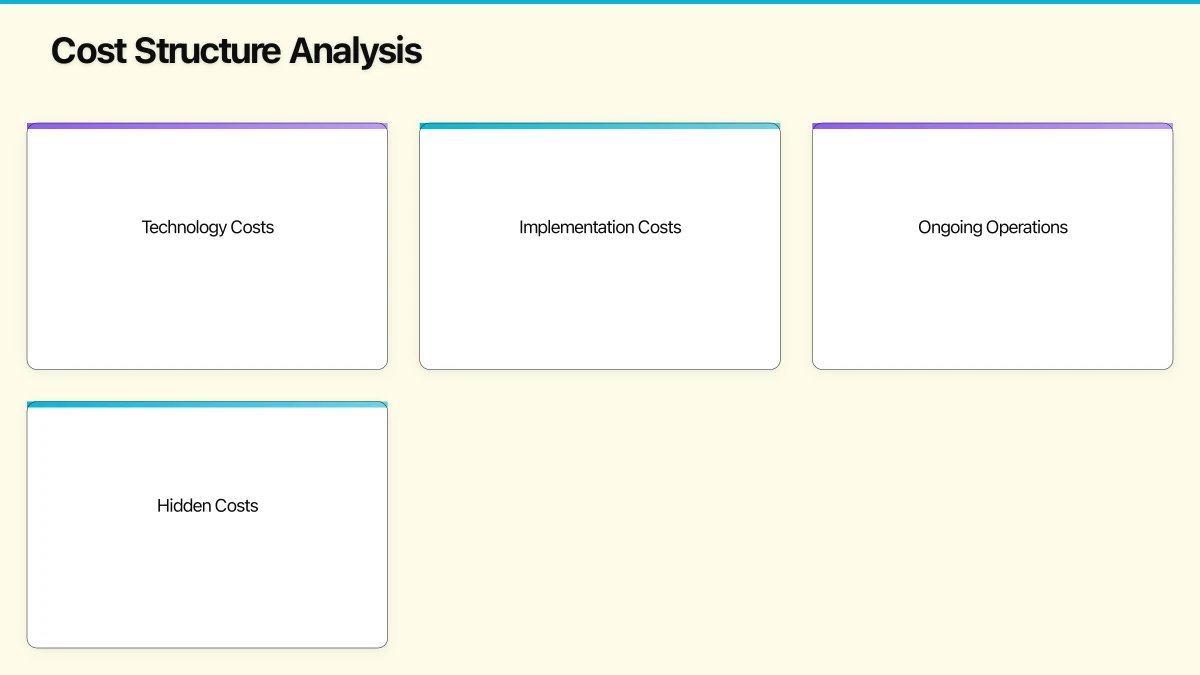
Understanding where generative AI creates enterprise value requires examining the technology’s fundamental capabilities and mapping them to business process improvements. Value creation typically falls into four categories, each with distinct measurement approaches and ROI characteristics.
Productivity Enhancement: Generative AI augments human workers, enabling them to accomplish more in less time. Content creation, code generation, document summarization, and communication drafting represent common productivity applications. ROI measurement focuses on time savings multiplied by labor costs, adjusted for quality and rework considerations.
Productivity gains are often the easiest to measure but can be misleading without careful analysis. A 30% reduction in document drafting time only translates to value if that time is productively redeployed. Organizations that measure time savings without tracking utilization of freed capacity often overstate actual ROI.
Quality Improvement: Beyond speed, generative AI can improve output quality through consistency, comprehensiveness, and reduced error rates. Customer service responses become more accurate and complete. Code review identifies issues human reviewers miss. Analysis incorporates broader context than manual processes can achieve.
Quality improvements require baseline measurement against which to compare AI-assisted outputs. Organizations should establish quality metrics before deployment, then track changes over time. Customer satisfaction scores, error rates, rework frequency, and audit findings provide quantifiable quality indicators.
Innovation Acceleration: Generative AI enables exploration of solution spaces that would be impractical to evaluate manually. Product design, marketing creative, strategic scenario analysis, and research synthesis can leverage AI to generate and evaluate more options faster.
Innovation value is inherently difficult to measure directly. Proxy metrics include time-to-market for new products, volume of ideas evaluated, and competitive differentiation assessments. Some organizations track “AI-enabled innovations” that would not have been feasible without generative capabilities.
New Capability Creation: The most transformative applications create entirely new capabilities previously impossible or economically unviable. Personalization at scale, real-time language translation, and adaptive learning systems represent capability creation rather than process improvement.
New capabilities require different ROI frameworks focused on strategic value rather than cost reduction. Market positioning, revenue enablement, and competitive advantage assessments replace traditional productivity calculations.
Use Case Prioritization Methodology
Not all generative AI applications deliver equal value. Systematic prioritization ensures investment focuses on high-impact opportunities while avoiding distractions that consume resources without proportionate returns.
Value Assessment Dimensions: Effective prioritization evaluates use cases across multiple dimensions:
Business Impact: What is the potential financial value if this use case succeeds? Consider revenue increase, cost reduction, risk mitigation, and strategic positioning. Quantify where possible; estimate ranges where precision is impossible.
Implementation Feasibility: How difficult is implementation given current capabilities? Assess data availability, technology readiness, integration complexity, and organizational change requirements. High-value but infeasible use cases should be staged for future consideration rather than immediate pursuit.
Time to Value: How quickly can value be realized? Quick wins build organizational momentum and generate learnings that inform subsequent initiatives. Long-horizon projects may deliver greater ultimate value but carry higher execution risk.
Strategic Alignment: Does this use case advance broader strategic objectives? AI investments should reinforce rather than distract from organizational priorities. Misaligned use cases, even if individually valuable, fragment attention and resources.
The Prioritization Matrix: Plotting use cases across value and feasibility dimensions reveals natural prioritization clusters:
Quick Wins: High feasibility, moderate value. These build momentum, generate organizational learning, and demonstrate AI capability. Pursue early to establish foundations.
Strategic Bets: High value, high feasibility. These represent core AI investments that should receive substantial resources and executive attention.
Future Opportunities: High value, low current feasibility. Document requirements and monitor for capability improvements that would enable pursuit.
Avoid: Low value regardless of feasibility. Don’t pursue simply because they’re easy or interesting.
Enterprise Use Case Analysis
Examining specific use cases across enterprise functions illustrates ROI dynamics and implementation considerations.
Customer Service and Support
Use Case: AI-assisted customer service representatives with real-time response suggestions, sentiment analysis, and knowledge base retrieval.
Value Drivers: Reduced average handle time (15-25% typical), improved first-contact resolution (10-20% improvement), enhanced customer satisfaction through consistent quality, and reduced training time for new agents.
Implementation Considerations: Integration with existing contact center platforms, knowledge base quality and completeness, agent adoption and workflow integration, and quality assurance processes for AI suggestions.
ROI Calculation Example: A 500-agent contact center with $45 average hourly fully-loaded cost achieving 20% handle time reduction generates approximately $4.5 million annual savings before implementation costs. Adding quality improvements and reduced attrition typically increases total value to $6-8 million annually.
Measurement Approach: Track handle time, resolution rates, customer satisfaction, and agent utilization before and after deployment. Establish control groups where feasible to isolate AI impact from other variables.
Software Development
Use Case: Code generation and completion, documentation generation, code review assistance, and test case generation.
Value Drivers: Developer productivity improvement (20-40% for coding tasks), reduced documentation debt, improved code quality through AI review, and accelerated onboarding for new developers.
Implementation Considerations: Security review of AI-generated code, integration with development environments, developer training and adoption, and intellectual property considerations for code suggestions.
ROI Calculation Example: A 200-developer organization with $150,000 average fully-loaded developer cost achieving 25% productivity improvement on coding tasks (roughly 40% of developer time) generates approximately $3 million annual value. Quality improvements and reduced technical debt add incremental value that compounds over time.
Measurement Approach: Track developer velocity metrics, code quality indicators, documentation coverage, and developer satisfaction. Use A/B testing where feasible to compare AI-assisted and unassisted developer cohorts.
Content and Marketing
Use Case: Marketing content generation, personalization at scale, creative variation testing, and content localization.
Value Drivers: Reduced content production costs (30-50% for initial drafts), increased content volume enabling broader reach, improved personalization driving conversion, and faster campaign execution.
Implementation Considerations: Brand voice consistency, quality control workflows, legal and compliance review, and integration with content management systems.
ROI Calculation Example: An organization spending $5 million annually on content production achieving 40% efficiency improvement generates $2 million in direct cost savings. Incremental revenue from increased content volume and improved personalization often exceeds direct savings, though attribution is more challenging.
Measurement Approach: Track content production volume and costs, campaign performance metrics, and conversion rates by personalization approach. Attribution modeling connects content improvements to business outcomes.
Knowledge Management and Research
Use Case: Document summarization, research synthesis, knowledge base maintenance, and expert system augmentation.
Value Drivers: Reduced time finding and synthesizing information (2-4 hours per week per knowledge worker), improved decision quality through comprehensive analysis, and reduced expertise concentration risk.
Implementation Considerations: Data quality and completeness, integration with document repositories, accuracy validation processes, and user training on effective AI interaction.
ROI Calculation Example: A professional services firm with 1,000 knowledge workers saving 3 hours weekly at $100/hour average generates $15 million annual value. Decision quality improvements, while harder to quantify, often represent larger value than time savings.
Measurement Approach: Survey-based time tracking, decision outcome analysis, and user satisfaction measurement. Establish baselines before deployment through time studies or diary methods.
Cost Structure Analysis
Comprehensive ROI analysis requires understanding generative AI cost structures, which differ significantly from traditional enterprise software.
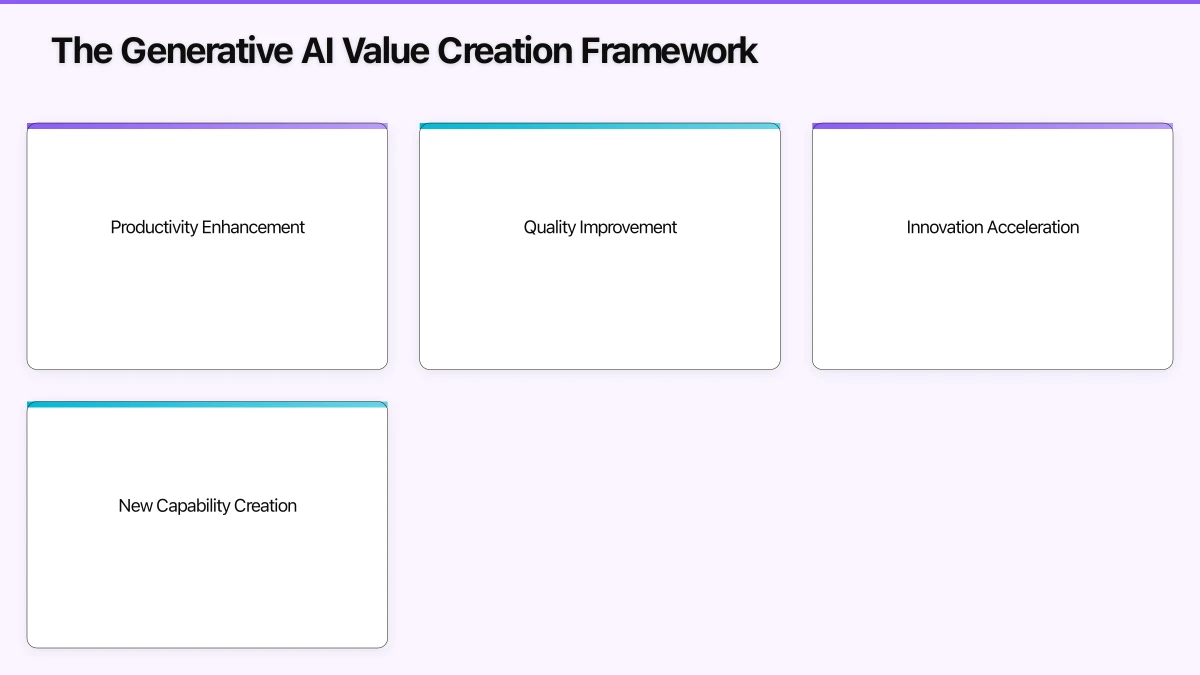
Technology Costs: AI platform and API costs, model hosting or fine-tuning expenses, integration development and maintenance, and infrastructure for data processing and storage.
API-based consumption models (OpenAI, Anthropic, Google Cloud) create variable costs that scale with usage. Volume discounts and commitment tiers reduce per-unit costs but require accurate demand forecasting. Self-hosted models eliminate API costs but introduce infrastructure and operational complexity.
Implementation Costs: Solution design and development, system integration, testing and validation, change management and training, and process redesign.
Implementation costs often exceed technology costs for complex deployments. Organizations underestimating implementation requirements frequently experience budget overruns and delayed value realization.
Ongoing Operations: Model monitoring and maintenance, quality assurance and human review, continuous improvement and optimization, and governance and compliance.
Generative AI systems require ongoing attention unlike traditional software deployments. Model performance can degrade, outputs require quality monitoring, and evolving business needs demand continuous refinement.
Hidden Costs: Opportunity cost of resources diverted from other initiatives, organizational change management, and risk mitigation and incident response.
Comprehensive cost analysis includes factors beyond direct expenditures. Organizations that ignore hidden costs consistently underestimate true investment requirements.
Building the Business Case
Effective generative AI business cases combine quantitative analysis with qualitative strategic assessment.
Quantitative Elements: Document specific value drivers with calculation methodologies, enumerate all cost categories with realistic estimates, project cash flows over appropriate time horizons (typically 3-5 years), calculate NPV and IRR using organizational hurdle rates, and include sensitivity analysis on key assumptions.
Qualitative Elements: Articulate strategic alignment with organizational priorities, identify competitive implications of action versus inaction, assess organizational readiness and change requirements, and outline risk factors and mitigation strategies.
Scenario Planning: Base case with realistic assumptions, upside case reflecting accelerated adoption or expanded scope, downside case addressing implementation challenges or adoption friction, and breakeven analysis identifying minimum performance thresholds.
Governance Requirements: Define approval authorities based on investment scale, establish stage gates for phased investments, specify reporting requirements and review cadences, and outline criteria for scaling, pivoting, or terminating initiatives.
Measuring and Validating ROI
Business case projections must be validated through actual performance measurement. Establishing measurement frameworks before deployment enables rigorous validation.
Baseline Establishment: Before deployment, document current state metrics for all value drivers identified in the business case. Use multiple measurement methods where feasible to ensure baseline accuracy. Baselines become impossible to establish after deployment changes processes.
Controlled Experimentation: Where feasible, use controlled experiments to isolate AI impact. A/B testing, pilot group comparisons, and phased rollouts enable attribution of changes to AI intervention rather than confounding variables.
Leading and Lagging Indicators: Leading indicators (adoption rates, usage patterns, user satisfaction) provide early signals. Lagging indicators (financial outcomes, business metrics) confirm value realization. Track both to enable course correction and validate ultimate value.
Attribution Methodology: Document how value will be attributed to AI investment versus other factors. Perfect attribution is impossible; reasonable methodology enables defensible claims.
Regular Reporting: Establish reporting cadences aligned to governance requirements. Monthly operational metrics, quarterly business reviews, and annual strategic assessments enable appropriate oversight at each level.
Common Pitfalls and Mitigation Strategies
Enterprise generative AI initiatives frequently encounter challenges that erode ROI. Anticipating these pitfalls enables proactive mitigation.
Overestimating Productivity Gains: Organizations often assume time savings translate directly to cost reduction or capacity increase. Reality involves transition costs, quality validation overhead, and incomplete adoption.
Mitigation: Apply realistic adoption curves and utilization factors. Assume 60-70% of theoretical maximum in initial projections.
Underestimating Implementation Complexity: Generative AI integration with enterprise systems requires significant engineering effort. Data preparation, workflow redesign, and change management consume more resources than anticipated.
Mitigation: Benchmark against similar implementations. Add contingency to implementation budgets and timelines.
Ignoring Quality Costs: AI outputs require human review for many applications. Quality assurance processes consume resources that offset productivity gains.
Mitigation: Include quality assurance in process design and cost models. Invest in confidence scoring and automated quality checks.
Neglecting Change Management: Technology deployment without adequate change management results in low adoption and minimal value realization.
Mitigation: Allocate significant change management resources. Budget 15-25% of implementation costs for training, communication, and adoption support.
Scope Creep: Initial use cases expand without corresponding business case updates, eroding ROI through unfunded scope.
Mitigation: Maintain disciplined scope control. Require business case updates for significant scope changes.
Strategic Recommendations for CTOs
Effective generative AI ROI realization requires strategic approaches beyond individual use case analysis.
Build Measurement Capabilities Early: Invest in data collection and analytics infrastructure that enables ROI measurement. Organizations lacking measurement capabilities cannot validate value or optimize investments.
Start with Quick Wins, Plan for Scale: Initial use cases should demonstrate value rapidly while establishing foundations for larger initiatives. Quick wins build organizational confidence and generate learnings that improve subsequent implementations.
Invest in Reusable Capabilities: Platforms, integrations, and processes that support multiple use cases generate better ROI than point solutions. Evaluate investments for reusability potential.
Maintain Portfolio Perspective: Individual use cases will underperform and outperform projections. Portfolio approaches diversify risk and ensure aggregate value delivery even when specific initiatives disappoint.
Plan for Evolution: Generative AI capabilities are evolving rapidly. Architecture and processes should accommodate capability improvements without complete redesign. Avoid overcommitting to current-generation approaches.
Balance Experimentation and Execution: Allocate resources to both scaling proven use cases and exploring emerging opportunities. Organizations that focus exclusively on either dimension miss value from the other.
Looking Forward: The Maturing Enterprise AI Landscape
Enterprise generative AI is transitioning from experimentation to operationalization. Organizations that established strong foundations in 2023-2024 are now scaling successful pilots while others continue searching for initial traction. This divergence will accelerate as leading organizations compound advantages through organizational learning and capability building.
For CTOs, the imperative is clear: develop rigorous ROI frameworks that enable rational investment decisions, implement measurement systems that validate value creation, and build organizational capabilities that compound over time. The organizations that master enterprise AI ROI will capture disproportionate value as the technology matures and becomes table stakes for competitive operation.
The window for establishing competitive advantage through generative AI is narrowing. Organizations that delay developing systematic approaches to AI value creation risk falling behind competitors who have already moved beyond experimentation to scaled deployment.
Sources
- McKinsey Global Institute. (2024). The Economic Potential of Generative AI: The Next Productivity Frontier. McKinsey & Company.
- Gartner. (2025). Predicts 2025: Generative AI in the Enterprise. Gartner Research.
- Forrester Research. (2024). The Total Economic Impact of Enterprise Generative AI. Forrester.
- Deloitte. (2024). State of Generative AI in the Enterprise. Deloitte Insights.
- Harvard Business Review. (2024). Measuring the ROI of Generative AI. Harvard Business Publishing.
Ash Ganda is a technology executive specializing in enterprise AI strategy and digital transformation. Connect on LinkedIn to discuss generative AI ROI frameworks for your organization.
For the practitioner’s view on mobile app development and app store success, explore Awesome Apps — where strategy meets the app store.
My consultancy Ganda Tech Services operates three specialist divisions covering cloud infrastructure, web development, and mobile apps for Australian businesses.
About the Author
Ashish Ganda is the founder of Ganda Tech Services, a Sydney-based technology consultancy specialising in cloud infrastructure, web development, and mobile app solutions for Australian businesses.
AI Strategy Primer for Australian Business Leaders
A practical framework for AI adoption in 2026 — cut through the hype and start with what matters.