The Future of Documentation: Strategic Approaches to Knowledge Capture and Sharing
The Knowledge Paradox
Enterprises have never had more documentation tools. Wikis, knowledge bases, document management systems, collaboration platforms—the options are endless. Yet knowledge management remains one of the most persistent challenges in enterprise technology.
The symptoms are familiar: documentation exists but can’t be found. Documents are found but are outdated. Current information exists in someone’s head but nowhere else. New employees take months to become productive. Critical knowledge walks out the door when people leave.
The paradox is that more documentation often makes things worse. When everything is documented, nothing stands out. Search returns thousands of results. Maintenance becomes impossible. Teams stop trusting the documentation and route around it.
The solution isn’t more documentation. It’s strategic documentation—knowing what to capture, how to structure it, and how to maintain it as a living asset rather than a write-once archive.
The Knowledge Hierarchy
Not all knowledge is equal. Effective documentation strategy requires understanding what types of knowledge matter and how each should be captured.
Explicit Knowledge
Information that can be clearly articulated and documented:
- Procedures and processes
- Technical specifications
- Policies and guidelines
- Reference data
This is the easiest to document but often the least valuable. Explicit knowledge is what most documentation captures—and why most documentation fails to address knowledge gaps.
Tacit Knowledge
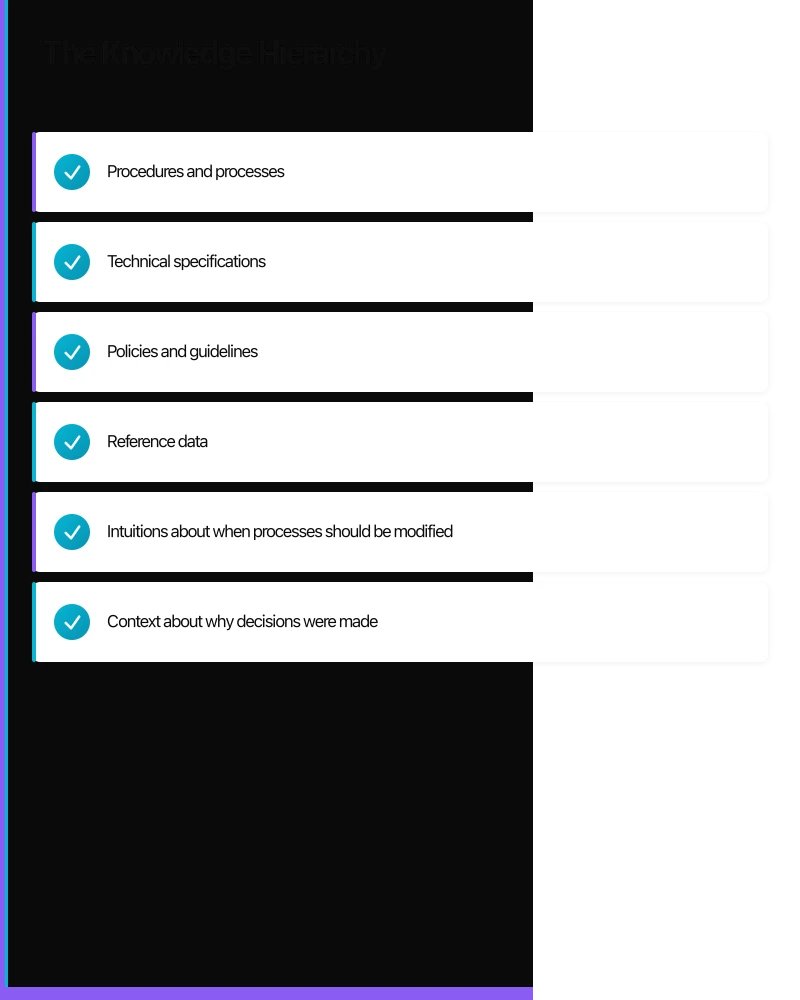
Knowledge embedded in experience that’s difficult to articulate:
- Intuitions about when processes should be modified
- Context about why decisions were made
- Understanding of stakeholder dynamics
- Patterns recognised from repeated experience
This is the knowledge that matters most—and the hardest to capture. When a senior engineer leaves, the procedures they documented stay. The tacit knowledge of why those procedures exist and when to deviate from them leaves with them.
Tribal Knowledge
Shared understanding within a team or organisation:
- Unwritten rules about how things work
- Historical context for current structures
- Relationship maps and informal authority
- Cultural norms around decision-making
Tribal knowledge often isn’t documented because everyone assumes everyone else knows it. New team members lack it and struggle to understand why things happen the way they do.
Strategic Documentation Framework
Layer 1: Foundational Documents
Documents that remain stable over time and provide baseline context.
Architecture Decision Records (ADRs) Capture significant architectural decisions:
# ADR-001: Use PostgreSQL for Primary Data Store

## Status
Accepted

## Context
We need a primary database for the customer platform.
Requirements: ACID compliance, JSON support, proven scale to 10TB+.

## Decision
PostgreSQL 15 with TimescaleDB extension for time-series data.

## Consequences
- Need PostgreSQL expertise on team
- Can leverage managed services (RDS, Cloud SQL)
- JSON support reduces need for separate document store
ADRs capture why decisions were made—the context that’s lost when only the decision is documented.
System Context Documentation High-level documentation of how systems fit together:
# Customer Platform Context

## Purpose
Central platform for customer data and engagement.

## Key Integrations
- CRM (Salesforce): customer master data sync
- Marketing (Marketo): campaign event ingestion
- Support (Zendesk): ticket data for customer 360

## Data Flows
[Diagram: Data flow between systems]

## Owners
Platform: @platform-team
Integrations: @integration-team
Runbooks Operational procedures for handling incidents:
# Runbook: Database Connection Exhaustion

## Symptoms
- Application timeouts
- PgBouncer "no more connections" errors
- Elevated database CPU

## Diagnosis
1. Check connection count: `SELECT count(*) FROM pg_stat_activity`
2. Check for long-running queries
3. Check for connection leaks in application logs

## Resolution
1. Identify and kill long-running queries if blocking
2. If connection leak, identify and restart affected service
3. If legitimate load, scale connection pool
Layer 2: Operational Documentation
Documents that change more frequently but maintain consistent structure.
Process Documentation Standard operating procedures with version control:
# Customer Onboarding Process
Version: 2.3 | Last Updated: 2024-02-15 | Owner: @onboarding-team

## Overview
Process for onboarding new enterprise customers.

## Prerequisites
- Signed contract
- Technical contact identified
- Security questionnaire completed

## Steps
1. Create customer account in admin portal
2. Configure SSO integration
3. Provision initial user accounts
4. Schedule kickoff meeting
5. Complete integration checklist

## Escalation
- Delays > 5 days: @onboarding-manager
- Technical blockers: @platform-engineering
API Documentation OpenAPI specifications with examples:
paths:
  /customers/{id}:
    get:
      summary: Get customer by ID
      description: |
        Returns customer details including current subscription status.
        Requires `customers:read` scope.
      parameters:
        - name: id
          in: path
          required: true
          schema:
            type: string
      responses:
        200:
          description: Customer found
          content:
            application/json:
              example:
                id: "cust_123"
                name: "Acme Corp"
                status: "active"
Layer 3: Evolving Knowledge
Knowledge that changes continuously and requires different capture approaches.
Decision Logs Lightweight capture of day-to-day decisions:
## 2024-02-15
- Decided to delay feature X to next sprint (need API changes from partner team)
- Approved using new logging library after spike
- Chose not to migrate legacy endpoint yet (usage still high)

## 2024-02-14
- Switched to cursor-based pagination for search endpoint
- Extended cache TTL for product catalogue to 1 hour
Not every decision needs an ADR. Decision logs capture smaller decisions that provide context without ceremony.
Lessons Learned Captured from incidents, projects, and retrospectives:
# Lesson: Database Migration Approach

## Context
During Q3 migration, we experienced extended downtime due to unexpected data volume.

## What Happened
- Estimated 2-hour migration took 8 hours
- Rollback was not tested and failed
- Customer communication was delayed

## What We Learned
- Always run migration on production-scale data copy first
- Test rollback as thoroughly as migration
- Pre-draft customer communications for delay scenarios

## Changes Made
- Added migration runbook template
- Required pre-production migration rehearsal
- Added communication templates to incident response
Layer 4: Just-in-Time Knowledge
Knowledge captured and shared in context rather than in dedicated documentation.
Code Comments Explain why, not what:
# We use a 30-second delay here because the payment processor
# doesn't guarantee idempotency for the first 15 seconds after
# a transaction. Discovered during incident INC-2345.
time.sleep(30)
Commit Messages Capture context that won’t be obvious later:
feat: Add retry logic to payment processing

Payment processor occasionally returns 503 during maintenance
windows. This adds exponential backoff with max 3 retries.

Fixes: JIRA-123
See also: INC-2345 (incident from Nov maintenance)
Pull Request Descriptions Document decisions made during implementation:
## What
Adds caching layer to product catalogue endpoint.

## Why
Current p99 latency is 850ms. Target is under 200ms.

## Alternatives Considered
- Database query optimisation: Tried, improved to 600ms, not enough
- CDN caching: Would require frontend changes

## Testing
- Load tested with 10x production traffic
- Verified cache invalidation on product updates
Information Architecture
Structural Principles
Single Source of Truth Each piece of knowledge lives in one place. References point to that place; duplicates are avoided.
Canonical: /docs/architecture/authentication.md
Reference: "See Authentication documentation" (with link)
Anti-pattern: Copy of authentication docs in three different wikis
Discoverability Over Organisation Focus on how people find information, not on perfect hierarchical organisation.
Multiple Entry Points:
- Search (primary for most users)
- Navigation (for exploration)
- Links in context (from related content)
- AI assistants (increasingly common)
Clear Hierarchy:
/docs
  /architecture     # How things work
  /operations       # How to run things
  /development      # How to build things
  /onboarding       # Getting started
  /reference        # Specifications, APIs
Consistent Structure: Templates ensure consistency:
# Document Title

## Overview
[Brief description of what this covers]

## Prerequisites
[What you need to know or have before using this]

## Content
[Main content sections]

## Related
[Links to related documentation]

## Changelog
[When this was last updated and what changed]
Search and Discovery
Most documentation access comes through search. Optimise for it.
Search-Friendly Content:
- Meaningful titles (not “Documentation”)
- Clear headings that describe content
- Keywords and synonyms included naturally
- Metadata: tags, categories, owner
Search Infrastructure:
- Full-text search across all documentation
- Faceted filtering (by type, team, date)
- Search analytics to identify gaps
AI-Assisted Discovery: RAG systems that answer questions from documentation:
User: "How do I connect to the production database?"
AI: "Based on the Database Access documentation, you need to..."
Maintenance as Strategy
Documentation degrades without active maintenance. Most documentation strategies fail here.
The Maintenance Problem
Scope Creep: Documentation grows without bound Staleness: Information becomes outdated Fragmentation: Same information in multiple places Ownership Gaps: No one responsible for updates
Sustainable Maintenance Patterns
Documentation as Code: Store documentation in version control alongside code:
/my-service
  /src
  /tests
  /docs
    architecture.md
    runbook.md
    api.md
Benefits:
- Changes to docs go through code review
- Documentation updates can be required with code changes
- History and blame available
- CI/CD can validate documentation
Ownership Assignment: Every document has an owner:
---
owner: @platform-team
reviewers: [@security-team]
review_frequency: quarterly
---
Automated Staleness Detection:
# In CI/CD
- name: Check documentation freshness
  run: |
    docs_older_than_6_months=$(find docs -mtime +180)
    if [ -n "$docs_older_than_6_months" ]; then
      echo "Stale documentation detected"
      exit 1
    fi
Documentation Reviews: Include documentation review in regular processes:
- Sprint retrospectives: “Is documentation current?”
- Quarterly reviews: Audit documentation health
- Incident post-mortems: Update runbooks
Retirement Strategy
Documents need end-of-life processes:
---
status: deprecated
deprecation_date: 2024-06-01
replacement: /docs/new-authentication.md
---

> **Deprecated:** This document describes the legacy authentication system.
> See [New Authentication](/docs/new-authentication.md) for current guidance.
Knowledge Capture Techniques
From Experts
Documentation Interviews: Structured conversations that extract tacit knowledge:
Questions:
- “Walk me through how you handle [situation]”
- “What would surprise a new team member about this?”
- “What do you wish you’d known when you started?”
- “What goes wrong most often? How do you prevent it?”
Shadowing and Observation: Watch experts work; document what they do and why.
Teaching as Documentation: Record training sessions and onboarding conversations. Transcribe and edit into documentation.
From Work
Incident Reviews: Every incident is a documentation opportunity:
- What knowledge would have prevented this?
- What knowledge was needed but missing during response?
- What should future responders know?
Project Retrospectives: What did we learn that others should know?
Code Review Patterns: Repeated code review comments suggest documentation gaps.
From New Perspectives
Onboarding Journaling: New employees document their experience:
- “I expected X but found Y”
- “I couldn’t find information about Z”
- “This confused me until I learned…”
This perspective is invaluable and temporary—capture it before new employees become insiders who forget what they didn’t know.
The Documentation Tech Stack
Core Components
Source of Truth: Git-based documentation (Markdown, MDX)
- Version control
- Review workflows
- Co-location with code
Publishing Platform: Static site generators (Docusaurus, GitBook, MkDocs)
- Clean reading experience
- Search functionality
- Customisation for branding
Collaboration: For real-time collaboration and drafts
- Google Docs, Notion, Confluence
- Export to source of truth when finalised
Diagrams: Mermaid, PlantUML, or draw.io diagrams in documentation
- Version-controlled
- Embedded in documentation
- Editable by contributors
Supporting Tools
Linting: Vale, markdownlint for consistency:
# .vale.ini
StylesPath = styles
MinAlertLevel = suggestion

[*.md]
BasedOnStyles = Vale, Documentation
Link Checking: Automated detection of broken links:
- name: Check links
  uses: lycheeverse/lychee-action@v1
  with:
    args: --verbose docs/
Change Detection: Notifications when documentation changes:
on:
  push:
    paths:
      - 'docs/**'
Measuring Documentation Effectiveness
Usage Metrics
Access Patterns:
- Page views by document
- Search queries
- Time on page
- Bounce rate
Gap Identification:
- Search queries with no results
- High-bounce pages
- Frequently asked questions not in documentation
Quality Metrics
Freshness:
- Average document age
- Percentage reviewed in last quarter
- Documents with no owner
Coverage:
- Documented vs. undocumented systems
- Runbook coverage for critical services
- API documentation completeness
Outcome Metrics
Onboarding Time: How long until new employees are productive?
Support Deflection: Do people find answers in documentation vs. asking others?
Incident Response: Are runbooks used and effective during incidents?
Building Documentation Culture
Tools and processes matter less than culture. Organisations where documentation thrives share common characteristics:
Leadership Models Behaviour: Leaders write and maintain documentation. They reference documentation in conversations. They ask “is this documented?” when making decisions.
Writing is Valued: Documentation contributions count in performance reviews. Strong writers are recognised. Writing skills are developed through feedback and training.
Accessibility is Prioritised: Documentation is easy to find, easy to read, and easy to contribute to. Barriers to contribution are actively reduced.
Maintenance is Expected: Updating documentation isn’t extra work—it’s part of the work. Outdated documentation is treated like technical debt.
Feedback Loops Exist: Users can easily report problems. Contributors receive feedback on their work. Analytics inform improvement.
The Strategic View
Documentation isn’t overhead. It’s knowledge infrastructure. Like other infrastructure, it requires investment, maintenance, and strategic thinking.
The organisations that treat documentation strategically—who understand what knowledge matters, how to capture it, and how to maintain it—build sustainable knowledge assets. Those who treat it as an afterthought experience the same knowledge problems repeatedly.
The future of documentation isn’t about better tools or more content. It’s about treating knowledge as a strategic asset worthy of the same attention enterprises give to code, data, and people.
That perspective—knowledge as asset—is the foundation of documentation that actually works.
Ash Ganda advises enterprise technology leaders on knowledge management, information architecture, and digital transformation strategy. Connect on LinkedIn for ongoing insights.
For technical deep-dives on the cloud and IT topics I cover strategically, visit Cloud Geeks — our specialist IT infrastructure blog.
Ganda Tech Services is my technology consultancy, bringing together cloud infrastructure, web development, and mobile expertise for Australian businesses.
About the Author
Ashish Ganda is the founder of Ganda Tech Services, a Sydney-based technology consultancy specialising in cloud infrastructure, web development, and mobile app solutions for Australian businesses.
Digital Transformation Roadmap 2026
A 12-month framework for Australian SMBs ready to modernise — phases, tools, and milestones.