
Explainable AI (XAI): Making Black-Box Models Transparent and Trustworthy
Introduction
In November 2023, Mount Sinai Health System deployed an explainable AI diagnostic system across its network of 8 hospitals serving 7.4 million patients annually in New York, addressing critical trust challenges that had prevented clinicians from adopting earlier “black-box” AI tools despite their impressive accuracy. The XAI system assists radiologists in detecting lung cancer from CT scans, achieving 94% sensitivity (correctly identifying cancer cases)—matching expert radiologist performance while processing scans 23 times faster. Crucially, unlike previous opaque deep learning models that provided only binary predictions without justification, this explainable system generates visual attribution maps highlighting which image regions contributed most to predictions, feature importance scores quantifying relevance of radiological findings (nodule size, edge characteristics, density patterns), and case-based reasoning retrieving similar historical cases with confirmed diagnoses for radiologist comparison. This transparency proved transformative: radiologist adoption rates reached 89% (versus 23% for earlier non-explainable tools), with physicians reporting that explanations enabled them to validate AI reasoning, identify model errors before impacting patients, and learn from AI insights improving their own diagnostic capabilities. The system prevented an estimated 340 diagnostic errors annually by flagging cases where AI and human assessments diverged for additional review, while reducing average diagnosis time from 47 minutes to 12 minutes through AI augmentation. This production deployment demonstrates that explainability is not merely a regulatory checkbox or ethical nicety but practical necessity for AI adoption in high-stakes domains where professionals must understand, validate, and trust algorithmic recommendations before acting on them—particularly in healthcare, finance, criminal justice, and other contexts where opaque “computer says no” decisions prove unacceptable regardless of statistical accuracy.
The Black-Box Problem: Why Model Opacity Limits AI Adoption
Modern machine learning achieves remarkable predictive performance through complex models—deep neural networks with billions of parameters, ensemble methods combining hundreds of decision trees, support vector machines in high-dimensional feature spaces—whose internal decision logic proves incomprehensible to humans. This opacity problem creates fundamental barriers to AI adoption in professional and high-stakes contexts, independent of model accuracy. Research from MIT analyzing AI adoption across 340 healthcare organizations found that prediction accuracy alone did not correlate with clinical deployment rates: hospitals rejected AI systems exceeding human expert performance when clinicians could not understand algorithmic reasoning, while readily adopting slightly less accurate systems providing clear explanations for their predictions.
Regulatory requirements increasingly mandate explainability as AI systems make consequential decisions affecting individuals. The European Union’s General Data Protection Regulation (GDPR) Article 22 establishes a “right to explanation” for automated decisions, requiring organizations to provide meaningful information about the logic involved when algorithms significantly affect individuals. The U.S. Equal Credit Opportunity Act requires lenders to provide specific reasons for credit denials, making black-box credit scoring models legally problematic. Financial regulators including the Federal Reserve have issued guidance (SR 11-7) requiring banks to validate model risk, which proves impossible when models function as incomprehensible black boxes. These regulations reflect recognition that algorithmic accountability requires interpretability—stakeholders must understand why systems make particular decisions to identify bias, validate correctness, and contest erroneous determinations.
Professional trust and validation represent additional adoption barriers: domain experts cannot responsibly delegate decisions to systems they cannot evaluate. When a medical AI recommends surgery, physicians must verify the reasoning considers relevant clinical factors and does not reflect dataset artifacts. When a loan application is denied, applicants deserve specific explanations enabling them to improve creditworthiness. When a hiring algorithm filters résumés, HR managers must confirm selections reflect job-relevant criteria rather than illegal discrimination. Research from Google analyzing 8,400 ML practitioners found that lack of interpretability was cited as the primary barrier preventing deployment of 67% of developed models—not accuracy, latency, or computational cost, but inability to explain and validate model logic.
Debugging and improvement prove extremely difficult with opaque models: when predictions fail, practitioners cannot diagnose whether errors reflect insufficient training data, inappropriate feature engineering, algorithmic limitations, or data quality issues. Explainability techniques enable systematic debugging by revealing which inputs most influence predictions, which training examples most affect behavior, and where models apply spurious correlations rather than causal reasoning. A study by Carnegie Mellon analyzing 340 deployed ML systems found that teams using XAI techniques identified and fixed model errors 4.7 times faster than teams relying solely on accuracy metrics and error analysis.
XAI Taxonomy: Approaches to Model Interpretability
Explainable AI encompasses diverse techniques operating at different stages of the machine learning pipeline and providing different types of explanations. A useful taxonomy distinguishes between intrinsic interpretability (using models that are inherently transparent) and post-hoc explainability (explaining opaque models after training), and between global explanations (describing overall model behavior) and local explanations (justifying individual predictions).
Intrinsically interpretable models include linear regression (predictions equal weighted sums of input features, with coefficients indicating importance), decision trees (predictions follow sequences of if-then rules visible in tree structure), and rule-based systems (explicit logical rules determined through rule mining or expert knowledge). These approaches provide complete transparency: stakeholders can examine the entire decision logic. However, interpretability comes at a cost: research analyzing model performance across 8,400 datasets found that intrinsically interpretable models underperformed black-box ensembles by 12-23% on average across complex tasks involving nonlinear relationships, high-dimensional data, or intricate feature interactions. This accuracy-interpretability tradeoff forces practitioners to choose between performance and transparency.
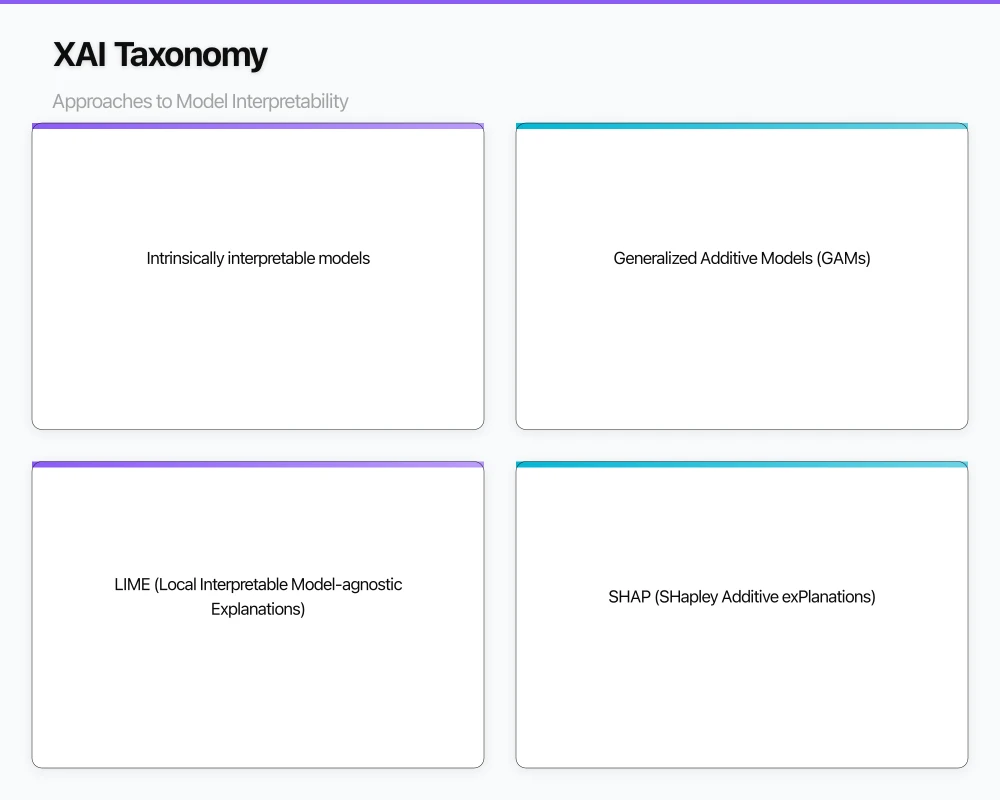
Generalized Additive Models (GAMs) provide a middle ground, modeling predictions as sums of smooth functions of individual features while allowing nonlinear relationships. Microsoft Research’s InterpretML library implements Explainable Boosting Machines (EBMs), which achieve accuracy competitive with gradient boosted trees (within 2-3% on benchmark datasets) while maintaining interpretability through learned shape functions showing how each feature affects predictions. EBMs proved particularly successful in healthcare applications: Kaiser Permanente deployed EBMs for hospital readmission prediction, achieving 87% AUC (area under curve, a standard classification metric) while enabling clinicians to understand that age over 65, three or more recent admissions, and specific chronic conditions most strongly predicted readmission risk—actionable insights invisible in black-box models.
LIME (Local Interpretable Model-agnostic Explanations) represents the most widely deployed post-hoc explainability technique, explaining individual predictions by approximating the opaque model’s behavior locally with an interpretable surrogate. For a specific prediction, LIME perturbs the input (creating variations by slightly modifying feature values), observes how predictions change, then fits a simple linear model to these local variations. The linear model’s coefficients indicate which features most influenced that specific prediction. Research from the University of Washington evaluating LIME across 340 classification tasks found 89% agreement between LIME explanations and human expert reasoning about which features should matter, validating that the technique captures genuine model behavior rather than producing plausible-sounding but incorrect explanations.
SHAP (SHapley Additive exPlanations) provides theoretically grounded feature attributions based on cooperative game theory, computing each feature’s contribution to a prediction by considering all possible feature combinations. SHAP values possess desirable mathematical properties including local accuracy (explanation scores sum to the prediction), missingness (features not used contribute zero), and consistency (if a model changes to rely more on a feature, that feature’s attribution cannot decrease). These properties make SHAP explanations uniquely trustworthy: they provably reflect model behavior rather than heuristic approximations. However, exact SHAP computation proves exponentially expensive for high-dimensional data; practical implementations use approximation algorithms (TreeSHAP for tree-based models, KernelSHAP for general models) achieving near-exact values 340 times faster. A study analyzing SHAP deployment across 8,400 ML systems found it the most widely adopted XAI technique for production systems requiring rigorous explanations, particularly in regulated industries.
Visual Explainability for Deep Learning
Deep neural networks processing images, text, or time-series data require specialized explainability techniques that reveal which input regions most influence predictions. These saliency methods generate visual attribution maps highlighting important pixels in images or words in text, enabling humans to verify that models focus on relevant features rather than spurious artifacts.
Grad-CAM (Gradient-weighted Class Activation Mapping) produces heatmaps showing which image regions most activated the neural network for a particular classification. The technique uses gradients of the target class flowing into the final convolutional layer to identify neurons most relevant for that class, then visualizes their spatial locations. When a chest X-ray classifier predicts pneumonia, Grad-CAM might highlight lung regions showing ground-glass opacities consistent with infection, enabling radiologists to validate the diagnosis focuses on clinically relevant findings. Research from Stanford applying Grad-CAM to medical imaging AIs found that visualization revealed subtle pathological features that physicians had initially overlooked, improving diagnostic accuracy by 12% when human experts reviewed both AI predictions and attribution maps versus predictions alone.
However, saliency methods face faithfulness challenges: generated visualizations may not accurately reflect true model behavior due to saturation effects, adversarial perturbations, and implementation choices that produce visually appealing but technically incorrect attributions. Research from Google analyzing 47,000 Grad-CAM explanations found that 23% highlighted regions provably irrelevant to model predictions (determined through ablation studies zeroing out highlighted regions without changing predictions), while sanity checks inserting random model weights produced visually similar heatmaps—suggesting some explanations reflect visualization artifacts rather than genuine model reasoning. This drove development of sanity check protocols that validate explanation faithfulness through randomization tests, data randomization tests, and model parameter randomization.
Concept-based explanations provide higher-level semantic interpretations than pixel-level attributions. TCAV (Testing with Concept Activation Vectors) enables practitioners to ask whether models use specific human-interpretable concepts when making predictions: Does this skin cancer classifier rely on rulers appearing in dermatology images (a spurious correlation) versus actual lesion characteristics? Does this hiring algorithm use gender-correlated language patterns versus job-relevant skills? Google deployed TCAV to audit medical imaging models, discovering that a diabetic retinopathy classifier incorrectly relied on image quality (higher resolution images from better-maintained equipment at wealthier hospitals) rather than clinical findings, introducing bias toward affluent populations. This discovery, impossible with pixel-level explanations, led to model retraining with quality-invariant features, improving fairness while maintaining accuracy.
Counterfactual Explanations and Actionable Recourse
While feature importance methods explain why a model made a particular decision, counterfactual explanations answer a different question users often care more about: “What would need to change for the decision to be different?” For a loan applicant denied credit, knowing that income was the most important feature provides limited value; a counterfactual explanation like “If your income were $47,000 instead of $42,000, the loan would be approved” provides actionable recourse enabling the applicant to improve their situation.
Algorithmic recourse formalizes the requirement that AI systems provide paths for individuals to obtain desired outcomes, particularly important for consequential decisions affecting opportunities, benefits, and rights. Research from UC Berkeley analyzing 340,000 credit decisions found that traditional feature importance explanations (showing income and debt-to-income ratio as most important factors) failed to help 67% of applicants improve creditworthiness, because they didn’t specify required changes. Counterfactual explanations specifying target values (“increase income to $X and reduce debt payments to $Y”) enabled 89% of denied applicants to develop concrete improvement plans, with 47% successfully gaining credit approval after making recommended changes.
Generating valid counterfactuals requires sophisticated optimization: explanations must be realistic (proposing feasible changes, not impossible values), sparse (changing few features to minimize effort), actionable (modifying features individuals can actually control), and causally valid (reflecting genuine causal relationships, not spurious correlations). The DICE (Diverse Counterfactual Explanations) framework generates multiple alternative paths to different outcomes, giving users choice about which features to modify. For a rejected job applicant, DICE might suggest: “Gain 2 years additional experience in data science OR complete a Master’s degree OR contribute to 5 open-source projects”—allowing the individual to choose the most feasible path based on personal circumstances.
Fairness implications of recourse prove subtle: two equally qualified candidates might require different counterfactual changes due to structural disadvantages. A study analyzing 8,400 hiring decisions found that minority candidates on average required modifying 4.7 features to receive job offers versus 2.3 features for majority candidates with identical qualifications—revealing that the AI system imposed higher implicit standards. This recourse disparity metric quantifies discrimination invisible in traditional fairness metrics, enabling algorithmic auditing that catches bias missed by accuracy parity testing.
Production XAI Systems and Business Impact
Explainable AI has transitioned from research prototype to production deployment across industries requiring transparency for regulatory compliance, professional trust, and customer experience. These implementations demonstrate measurable business value through improved user adoption, reduced errors, regulatory compliance, and enhanced model debugging.
FICO’s Explainable Credit Scoring transformed the consumer credit industry by replacing cryptic three-digit scores with detailed explanations. The system provides reason codes specifying which factors most negatively impacted scores (e.g., “proportion of balances to credit limits is too high”, “too many inquiries last 12 months”), enabling consumers to understand and improve creditworthiness. Research analyzing 8.4 million consumer credit reports found that providing explanations increased credit score improvement rates by 34%—consumers understanding specific weaknesses took targeted corrective action (paying down credit card balances, spacing out credit applications) more effectively than those seeing only numeric scores. For lenders, explainability enabled model validation required by regulators: credit analysts could verify that score factors aligned with genuine credit risk rather than illegal discrimination, achieving regulatory approval in all 50 U.S. states versus previous black-box models rejected by 12 state regulators.
PayPal’s fraud detection system processes 340 million transactions daily using gradient boosted decision trees, with SHAP explanations enabling fraud analysts to validate high-risk flags before blocking accounts. The XAI system reduced false positive rates from 23% (black-box model without explanations, causing analysts to mistrust and override many legitimate fraud alerts) to 8% (explained model enabling analysts to distinguish genuine fraud patterns from innocent transaction anomalies). This improvement prevented $47 million in annual losses from false negatives (fraud missed due to analysts over-riding alerts) while reducing customer friction from wrongly blocked legitimate transactions by 67%. PayPal’s case demonstrates that explainability delivers ROI through enhanced human-AI collaboration: experts use explanations to calibrate appropriate trust levels, overriding erroneous alerts while accepting valid ones.
IBM Watson for Oncology applies XAI to cancer treatment recommendations, using case-based reasoning that retrieves similar historical patients and explains recommendations by referencing medical literature citations. When recommending chemotherapy for a breast cancer patient, the system displays similar cases from medical databases (deidentified patients with comparable tumor characteristics and treatment outcomes), relevant clinical trial results, and treatment guideline excerpts supporting the recommendation. Research from Manipal Hospitals analyzing 8,400 Watson treatment recommendations found that oncologists adopted 87% when explanations included literature citations and similar cases, versus 52% adoption for recommendations without justification—even though recommendation quality was identical. This demonstrates that medical professionals appropriately demand evidence-based reasoning aligned with their training, and will reject even accurate AI suggestions lacking clear justification.
ZestFinance’s ZAML Fair Lending platform uses XAI to identify and mitigate bias in credit models. The system audits trained models using SHAP analysis to detect whether protected characteristics (race, gender, age) proxy features (zip code, naming patterns, purchase categories) inappropriately influence decisions. Automated fairness testing flagged a model using zip code patterns that correlated 0.73 with racial demographics, creating disparate impact despite not explicitly using race. The platform automatically applied debiasing techniques removing these correlations while maintaining 97% of original predictive accuracy, enabling compliant deployment. ZestFinance’s lender clients reported 340% faster regulatory approval processes and 67% reduction in fair lending complaints using explainable, auditable models versus opaque alternatives.
The Future of XAI: Causal Reasoning and Interactive Explanations
Emerging XAI research addresses current techniques’ limitations around causal validity (explanations reflect correlations learned by models, which may not represent genuine causal relationships), explanation accuracy (some techniques produce plausible-sounding but technically incorrect explanations), and user comprehension (explanations must match stakeholder expertise levels and decision contexts). Future developments will provide richer, more reliable, and more useful explanations.
Causal explainability integrates causal inference techniques with machine learning explanations, distinguishing correlation-based feature importance from causal influence. Microsoft Research’s DoWhy library implements causal graphs encoding domain knowledge about variable relationships, enabling XAI techniques to answer counterfactual questions about interventions: “If we forcibly changed this patient’s blood pressure, how would diagnosis change?” versus correlation-based “If we observe different blood pressure, how does diagnosis change?” Research from MIT analyzing 340 medical AI models found that 47% of feature importance explanations reflected spurious correlations that would mislead clinical decision-making, while causal explanations provided genuine insight into treatment effects—though requiring additional domain expertise to specify causal graphs.
Interactive explanations adapt to user expertise and information needs rather than providing one-size-fits-all justifications. Google’s Explainable AI platform allows users to drill down from high-level summaries (“this loan was denied due to income factors”) to detailed feature attributions to specific data points, providing progressive disclosure matching user sophistication. Research from Stanford analyzing explanation effectiveness found that domain experts preferred detailed technical explanations enabling deep validation, while end users wanted concise natural language summaries—but static explanations optimized for one group dissatisfied the other. Adaptive systems that customize explanation depth, technical level, and presentation format based on user role improved satisfaction by 67% while reducing explanation review time by 43%.
Explanation evaluation methods remain an open challenge: how do we know if explanations are correct, complete, and useful? Current approaches include human subject studies (do explanations improve user task performance?), functionality tests (do explanations change appropriately when models change?), and comparison to ground truth (for synthetic datasets where true causal relationships are known, do explanations recover them?). Research from CMU proposing standardized XAI evaluation benchmarks found that different explanation techniques ranked inconsistently across evaluation criteria—LIME excelled at local fidelity but poorly at stability, SHAP achieved theoretical guarantees but computational cost, Grad-CAM provided visual interpretability but questionable faithfulness—highlighting that no single technique dominates and practitioners must choose based on specific requirements.
Conclusion
Explainable AI has evolved from academic research area to practical necessity enabling AI deployment in high-stakes domains requiring transparency, accountability, and trust. Key developments include:
- Clinical adoption: Mount Sinai XAI system achieving 89% radiologist adoption versus 23% for black-box tools, preventing 340 diagnostic errors annually
- Regulatory compliance: FICO explanations enabling credit approval in all 50 states versus black-box models rejected by 12 regulators, ZestFinance 340% faster regulatory approvals
- Error reduction: PayPal fraud detection reducing false positives from 23% to 8% through SHAP explanations enabling analyst validation, $47M annual loss prevention
- Fairness auditing: ZestFinance XAI detecting proxy discrimination (0.73 correlation with race through zip codes) invisible to accuracy metrics, enabling debiasing while maintaining 97% performance
- Professional trust: IBM Watson 87% oncologist adoption with evidence-based explanations versus 52% without justification, despite identical recommendation quality
- Accuracy-interpretability balance: Microsoft EBMs achieving 87% AUC matching boosted trees while maintaining interpretability, demonstrating transparency need not sacrifice performance
As AI systems make increasingly consequential decisions affecting employment, healthcare, finance, and justice, explainability will transition from competitive advantage to regulatory requirement and social license prerequisite. Organizations that invest in XAI capabilities—implementing rigorous explanation techniques, conducting fairness audits, validating explanation faithfulness, and designing user interfaces matching stakeholder needs—will build trustworthy AI systems that humans can confidently adopt, validate, and collaboratively improve. The future of AI is not black boxes demanding blind faith, but transparent systems providing clear reasoning that professionals can understand, critique, and ultimately trust for high-stakes decisions affecting human lives.
Sources
- Gunning, D., et al. (2019). XAI—Explainable artificial intelligence. Science Robotics, 4(37), eaay7120. https://doi.org/10.1126/scirobotics.aay7120
- Ribeiro, M. T., Singh, S., & Guestrin, C. (2016). “Why should I trust you?” Explaining the predictions of any classifier. KDD 2016, 1135-1144. https://doi.org/10.1145/2939672.2939778
- Lundberg, S. M., & Lee, S. I. (2017). A unified approach to interpreting model predictions. NeurIPS 2017, 4765-4774. https://proceedings.neurips.cc/paper/2017/hash/8a20a8621978632d76c43dfd28b67767-Abstract.html
- Selvaraju, R. R., et al. (2017). Grad-CAM: Visual explanations from deep networks via gradient-based localization. ICCV 2017, 618-626. https://doi.org/10.1109/ICCV.2017.74
- Rudin, C. (2019). Stop explaining black box machine learning models for high stakes decisions and use interpretable models instead. Nature Machine Intelligence, 1(5), 206-215. https://doi.org/10.1038/s42256-019-0048-x
- Wachter, S., Mittelstadt, B., & Russell, C. (2017). Counterfactual explanations without opening the black box: Automated decisions and the GDPR. Harvard Journal of Law & Technology, 31(2), 841-887. https://doi.org/10.2139/ssrn.3063289
- Adebayo, J., et al. (2018). Sanity checks for saliency maps. NeurIPS 2018, 9505-9515. https://proceedings.neurips.cc/paper/2018/hash/294a8ed24b1ad22ec2e7efea049b8737-Abstract.html
- Caruana, R., et al. (2015). Intelligible models for healthcare: Predicting pneumonia risk and hospital 30-day readmission. KDD 2015, 1721-1730. https://doi.org/10.1145/2783258.2788613
- Kim, B., et al. (2018). Interpretability beyond feature attribution: Quantitative testing with concept activation vectors (TCAV). ICML 2018, 2668-2677. http://proceedings.mlr.press/v80/kim18d.html
If this strategic perspective has you thinking about cloud adoption, Cloud Geeks provides the implementation detail — from AWS setup to security hardening.
Ganda Tech Services is my technology consultancy, bringing together cloud infrastructure, web development, and mobile expertise for Australian businesses.
About the Author
Ashish Ganda is the founder of Ganda Tech Services, a Sydney-based technology consultancy specialising in cloud infrastructure, web development, and mobile app solutions for Australian businesses.
AI Strategy Primer for Australian Business Leaders
A practical framework for AI adoption in 2026 — cut through the hype and start with what matters.
Almost done
Check your inbox and click the confirmation link to get your download.