Enterprise Container Security: From Image to Runtime
Container adoption in the enterprise has reached the point where security can no longer be treated as a secondary concern. The convenience and speed that containers provide for development and deployment must be matched by a security posture that satisfies enterprise requirements for production workloads handling sensitive data and business-critical processes.
The container security challenge is distinct from traditional application security in several important ways. Container images are built from layers, each potentially introducing vulnerabilities. Images are immutable once built, meaning security must be assessed before deployment rather than patched in place. Container orchestration platforms like Kubernetes introduce a new control plane with its own attack surface. And the ephemeral nature of containers — short-lived, frequently replaced — demands security approaches that operate at machine speed rather than human speed.
The 2020 and early 2021 security landscape has reinforced the urgency. The SolarWinds supply chain attack demonstrated how compromised build processes can inject malicious code into trusted software. Vulnerabilities in container runtimes and orchestration platforms continue to be discovered. Cryptomining attacks targeting misconfigured Kubernetes clusters are widespread. The enterprise CTO must establish a container security strategy that addresses the full lifecycle — from image creation through deployment to runtime — with defence in depth at every stage.
Image Supply Chain Security
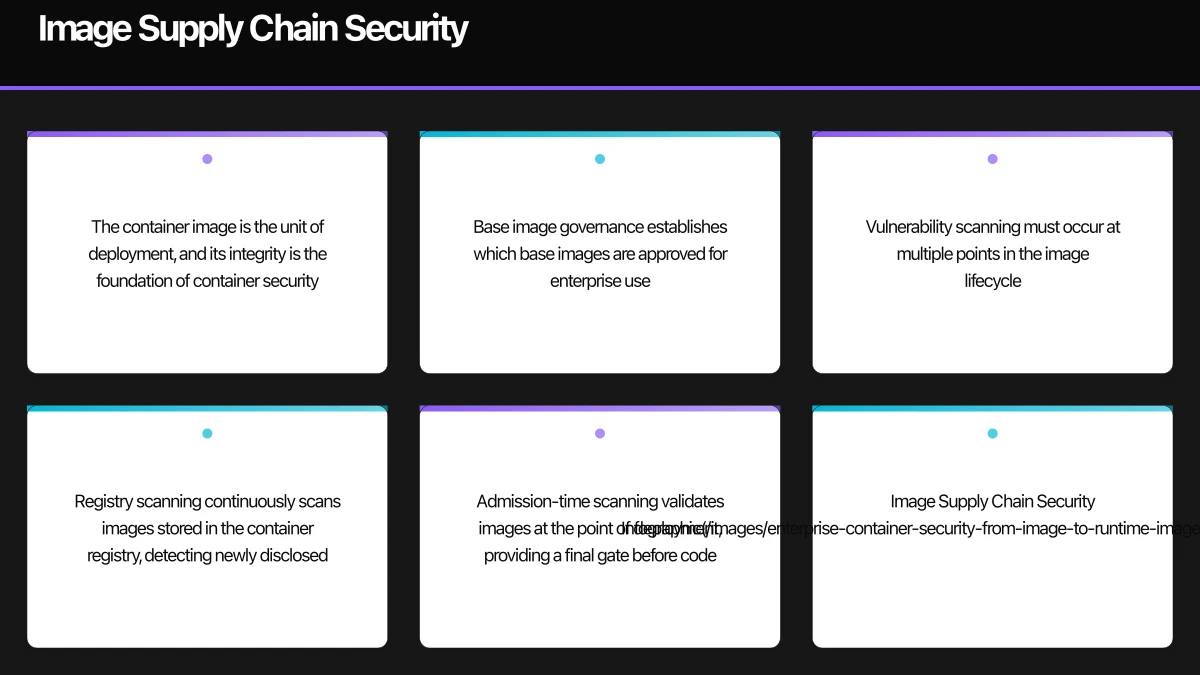
The container image is the unit of deployment, and its integrity is the foundation of container security. A compromised image that passes into production can execute arbitrary code within the enterprise environment, making image supply chain security the first priority.
Base image governance establishes which base images are approved for enterprise use. Rather than allowing teams to use arbitrary images from Docker Hub, the organisation should maintain a curated catalogue of approved base images that have been vetted for security, licensing, and maintenance status. These base images should be rebuilt regularly to incorporate operating system security patches, and the rebuild process should be automated and auditable.
Vulnerability scanning must occur at multiple points in the image lifecycle. Build-time scanning integrates with the CI/CD pipeline, scanning newly built images against vulnerability databases (CVE) and failing the build if critical vulnerabilities are detected. Registry scanning continuously scans images stored in the container registry, detecting newly disclosed vulnerabilities in previously clean images. Admission-time scanning validates images at the point of deployment, providing a final gate before code reaches the cluster.
Trivy, Anchore, Snyk Container, and Aqua Security are among the tools providing container image scanning. The choice depends on integration requirements, vulnerability database coverage, and the depth of analysis needed. Beyond CVE-based scanning, some tools provide malware detection, secret detection (credentials or API keys accidentally embedded in images), and license compliance checking.
Image signing and verification ensure that only images from trusted build processes are deployed. The image signing process creates a cryptographic signature during the build pipeline that attests to the image’s provenance. At deployment time, the orchestration platform verifies this signature before allowing the image to run. Notary (part of the CNCF), cosign (from the sigstore project), and Docker Content Trust provide image signing capabilities. Kubernetes admission controllers can enforce signature verification, rejecting unsigned or invalidly signed images.
Minimising the image attack surface is a fundamental security practice. Images should contain only the components needed to run the application — no shells, package managers, debugging tools, or unnecessary libraries. Distroless images, popularised by Google, provide minimal base images that contain only the application runtime and its dependencies. Alpine Linux-based images offer a compromise with a minimal operating system that includes basic utilities. Multi-stage Docker builds enable compilation and build-time dependencies to be excluded from the final runtime image.
Kubernetes Security Configuration
The Kubernetes control plane and its configuration represent a significant attack surface that must be hardened for enterprise use.
RBAC (Role-Based Access Control) in Kubernetes controls who can perform which operations on which resources. Enterprise RBAC configurations should follow the principle of least privilege, granting only the permissions each user and service account requires. Default service accounts should have minimal permissions — the default behaviour of mounting a service account token in every pod should be disabled for pods that do not need Kubernetes API access.
Pod security is enforced through Pod Security Standards (which are replacing the deprecated Pod Security Policies). Enterprise deployments should enforce the restricted profile as the default, which prevents privilege escalation, requires non-root execution, drops all Linux capabilities, and enforces read-only root filesystems. Workloads that legitimately require elevated privileges should be exceptions, granted through namespace-specific policies with documented justification.
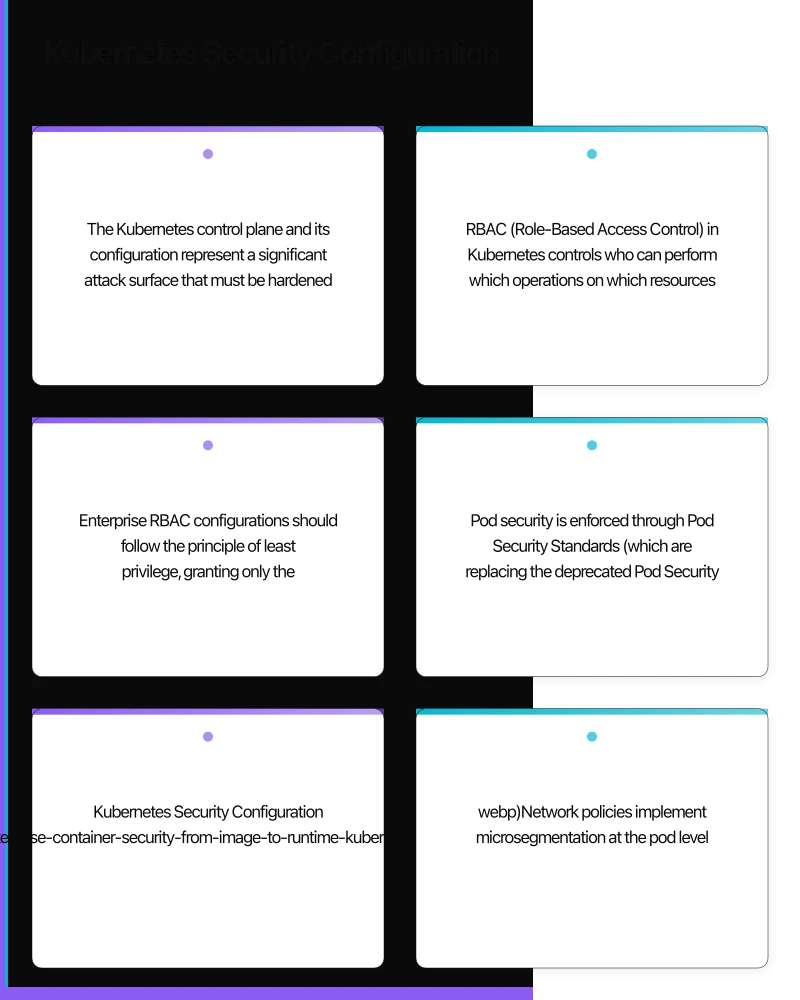
Network policies implement microsegmentation at the pod level. The default Kubernetes networking model allows all pods to communicate with all other pods — a flat network that is unacceptable in enterprise environments. Network policies define explicit ingress and egress rules for each workload, implementing a zero-trust networking model. The starting point should be a default-deny policy that blocks all traffic, with explicit allow rules for each required communication path.
Secrets management in Kubernetes requires careful attention. Kubernetes Secrets are base64-encoded but not encrypted by default in etcd. Enterprise deployments should enable etcd encryption at rest and consider external secrets management solutions — HashiCorp Vault, AWS Secrets Manager, Azure Key Vault — with Kubernetes integration through the CSI Secrets Store driver or operator patterns. Secrets should be rotated regularly, and secret access should be audited.
Admission controllers provide policy enforcement at the API server level. Open Policy Agent (OPA) with its Gatekeeper integration enables custom policies that evaluate every resource creation and modification against organisational rules. Policies can enforce image registry restrictions (only images from the approved registry), resource limits (every pod must specify CPU and memory limits), label requirements (every deployment must include cost centre and team labels), and any other organisational standards.
Runtime Security
Security at runtime addresses threats that bypass build-time and admission-time controls — compromised applications, exploited vulnerabilities, and insider threats.
Runtime monitoring tracks container behaviour against expected patterns. Tools like Falco (an open-source runtime security project from the CNCF), Aqua Runtime Protection, and Sysdig Secure monitor system calls, network connections, and file system activity within containers. Anomalous behaviour — a container spawning an unexpected process, making an unusual network connection, or modifying a file that should be read-only — triggers alerts and can trigger automated response actions like container termination.
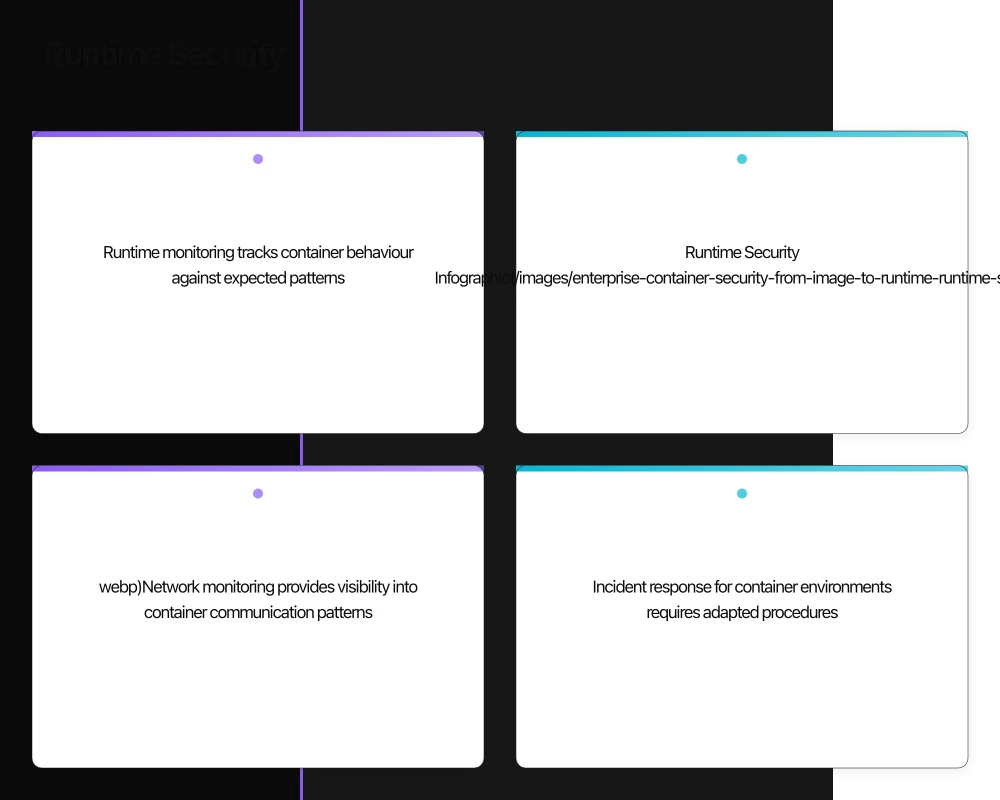
Network monitoring provides visibility into container communication patterns. Service mesh platforms like Istio and Linkerd provide mutual TLS between services (ensuring encrypted, authenticated communication), traffic visibility, and the ability to enforce communication policies. For enterprises, the mutual TLS capability is particularly valuable — it provides encryption and authentication for all inter-service communication without requiring application-level changes.
Incident response for container environments requires adapted procedures. The ephemeral nature of containers means that a compromised container may be replaced before forensic investigation can occur. Container forensics tools that capture container state (file system, process list, network connections) at the time of detection provide the evidence needed for investigation. Immutable logging infrastructure ensures that audit trails cannot be tampered with by an attacker who gains container access.
The enterprise container security strategy is not a single tool or technology — it is a layered defence model that addresses threats at every stage of the container lifecycle. The CTO who invests in this comprehensive approach builds the security foundation that enables the enterprise to capture the agility benefits of containerisation without accepting unacceptable risk.
Turning strategy into infrastructure? Cloud Geeks covers managed cloud, DevOps, and IT security for businesses putting digital plans into action.
As founder of Ganda Tech Services, I work with Australian businesses to align technology investments with business growth — across cloud, web, and mobile.
About the Author
Ashish Ganda is the founder of Ganda Tech Services, a Sydney-based technology consultancy specialising in cloud infrastructure, web development, and mobile app solutions for Australian businesses.
AI Strategy Primer for Australian Business Leaders
A practical framework for AI adoption in 2026 — cut through the hype and start with what matters.