DevOps Transformation: The Enterprise Journey from Silos to Flow
Introduction
DevOps has moved from buzzword to business imperative. Organisations that deliver software quickly and reliably outperform those that don’t—not marginally, but dramatically. Research consistently shows that elite performers deploy hundreds or thousands of times more frequently than low performers, with better stability.
Yet many enterprise DevOps initiatives stall. Tools get purchased. Pipelines get built. But the promised transformation doesn’t materialise. Teams still work in silos. Deployments still feel risky. The business still waits.
The gap between DevOps aspiration and reality comes down to treating DevOps as a technology problem rather than an organisational one. This guide covers how to lead transformation that actually delivers.
What DevOps Actually Means
Beyond Tools
DevOps is not:
- A tool or platform to purchase
- A team to create
- A job title to hire
- A process to implement
DevOps is a set of practices and cultural norms that enable organisations to deliver software faster and more reliably.
The Core Principles
Flow
Work should move smoothly from idea to production:
- Small batch sizes
- Continuous integration and delivery
- Automated testing and deployment
- Fast feedback loops
Feedback
Problems should be detected and addressed quickly:
- Monitoring and observability
- Incident response
- Post-incident learning
- Customer feedback integration
Continuous Learning
Organisations should improve continuously:
- Experimentation culture
- Blameless post-mortems
- Knowledge sharing
- Investment in improvement
The Business Case
Why does this matter to the business?
Speed to Market
Features reach customers faster. Competitive response improves. Revenue realisation accelerates.
Quality
Automated testing catches issues early. Smaller changes are easier to debug. Recovery from problems is faster.
Efficiency
Automation reduces manual work. Engineers spend time on value creation, not repetitive tasks.
Employee Satisfaction
Engineers prefer working in high-performing environments. Recruitment and retention improve.
Assessing Current State
Maturity Dimensions
Evaluate your organisation across key dimensions:
Deployment Frequency
How often do you deploy to production?
- Low: Monthly or less
- Medium: Weekly
- High: Daily
- Elite: Multiple times per day
Lead Time
How long from code commit to production?
- Low: More than a month
- Medium: One week to one month
- High: One day to one week
- Elite: Less than one day
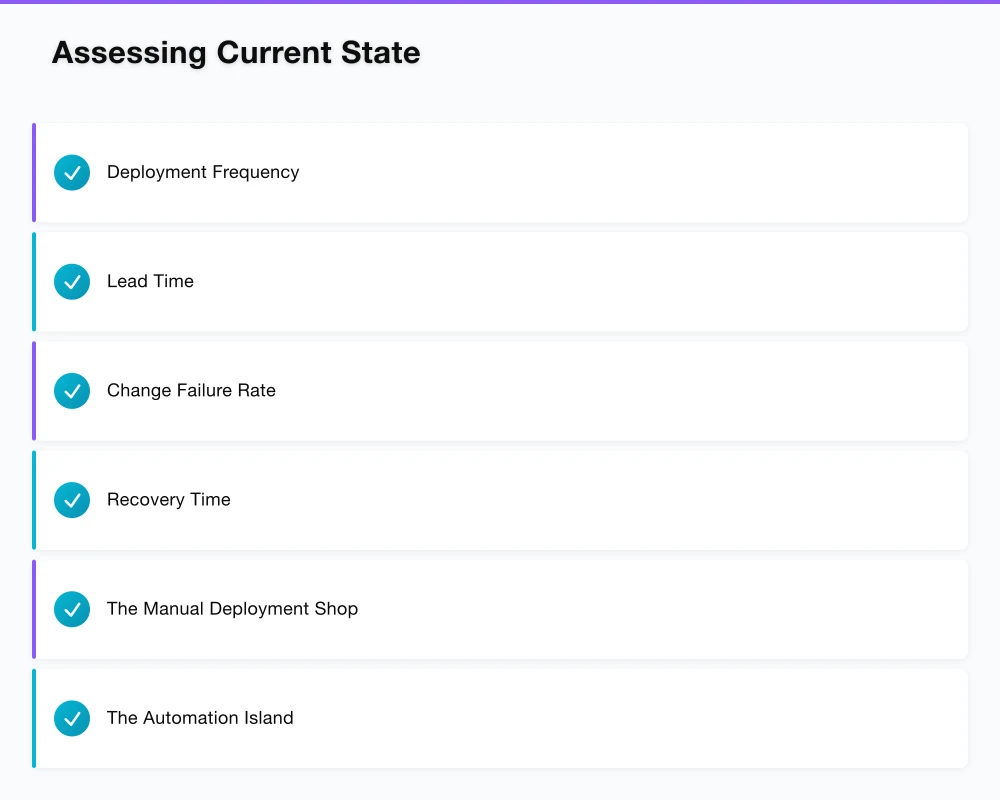
What percentage of changes cause problems?
- Low: More than 45%
- Medium: 16-30%
- High: 0-15%
- Elite: 0-15%
Recovery Time
How long to recover from incidents?
- Low: More than a week
- Medium: One day to one week
- High: Less than one day
- Elite: Less than one hour
Common Patterns
The Manual Deployment Shop
Deployments are manual, risky events. Teams avoid deploying. Large batches accumulate risk. Recovery is slow and painful.
The Automation Island
Some teams have good practices. Others don’t. No consistency. Knowledge doesn’t spread. Organisation-wide metrics are poor.
The Tool-Heavy, Culture-Light
Expensive tools purchased. Pipelines built. But culture unchanged. Tools used to automate old processes rather than enable new ones.
The Shadow DevOps
Innovative teams work around official processes. Good practices exist but aren’t sanctioned or supported.
Transformation Strategy
Leadership Commitment
Transformation requires sustained leadership attention:
Executive Sponsorship
- Clear mandate for change
- Resource commitment
- Barrier removal
- Visible support
Middle Management Engagement
- Managers enabled to change
- Metrics aligned with new goals
- Permission to experiment
- Support for learning
Without leadership commitment, initiatives become isolated efforts that don’t scale.
Start with Why
Connect transformation to business outcomes:
- “We need to respond faster to market changes”
- “Our deployment risk is unacceptable”
- “We’re losing engineers to better environments”
- “Our competitors are outpacing us”
Abstract DevOps benefits don’t motivate. Concrete business problems do.
Pilot and Expand
Don’t try to transform everything at once:
Select Pilot Teams
Choose teams that are:
- Willing and motivated
- Representative of challenges
- Likely to succeed
- Visible to the organisation
Enable Deep Success
Help pilots achieve genuinely better outcomes:
- Dedicated support
- Resource allocation
- Barrier removal
- Patience for learning
Extract and Share Patterns
Document what works:
- Practices that helped
- Tools that enabled
- Challenges overcome
- Metrics improved
Expand Systematically
Grow adoption deliberately:
- Next wave of teams
- Internal champions
- Shared platforms
- Training and enablement
Key Practices
Continuous Integration
The Practice
Developers integrate code frequently (at least daily). Each integration is verified by automated build and test.
Why It Matters
- Integration problems found immediately
- Small changes easier to debug
- Always-working codebase
- Foundation for continuous delivery
Implementation
- Trunk-based development or short-lived branches
- Automated build on every commit
- Fast, reliable test suites
- Broken builds fixed immediately
Continuous Delivery
The Practice
Code is always in a deployable state. Deployment to any environment is automated and low-risk.
Why It Matters
- Deployment becomes routine
- Risk is reduced through frequency
- Feedback cycles shorten
- Release decisions become business decisions
Implementation
- Automated deployment pipelines
- Environment parity (dev, staging, production similar)
- Feature flags for incomplete work
- Automated rollback capabilities
Infrastructure as Code
The Practice
Infrastructure is defined in version-controlled code, not manually configured.
Why It Matters
- Reproducible environments
- Change tracking and audit
- Disaster recovery capability
- Reduced configuration drift
Implementation
- Tools like Terraform, CloudFormation, Pulumi
- Version control for all infrastructure
- Automated provisioning
- Immutable infrastructure patterns
Monitoring and Observability
The Practice
Systems are instrumented to provide visibility into behaviour. Problems are detected before customers notice.
Why It Matters
- Fast problem detection
- Evidence-based debugging
- Capacity planning data
- Understanding of system behaviour
Implementation
- Metrics, logs, and traces
- Dashboards and alerting
- On-call processes
- Incident response procedures
Blameless Post-Mortems
The Practice
After incidents, teams analyse what happened without blaming individuals. Focus is on systemic improvement.
Why It Matters
- Psychological safety for honesty
- Learning from failures
- Systemic improvements
- Prevention of recurrence
Implementation
- Structured post-mortem process
- Written records shared broadly
- Action items tracked to completion
- Culture of learning, not blame
Organisational Changes
Team Structure
Cross-Functional Teams
Teams should have all skills needed to deliver:
- Development
- Testing
- Operations
- Security
Reduce handoffs between specialised teams.
Product Alignment
Teams should own products or services:
- Clear ownership
- End-to-end responsibility
- Direct customer connection
- Autonomous decision-making
Platform Teams
Provide shared capabilities:
- CI/CD infrastructure
- Monitoring platforms
- Security tooling
- Developer experience
Enable product teams rather than gatekeeping.
Process Changes
Reduce Approval Gates
Manual approvals slow flow. Replace with:
- Automated testing
- Peer review
- Automated compliance checks
- Post-deployment verification
Shift Left
Move quality activities earlier:
- Security scanning in development
- Performance testing in CI
- Compliance verification automated
- Design reviews before coding
Measure Flow
Track metrics that matter:
- Deployment frequency
- Lead time
- Change failure rate
- Recovery time
Cultural Shifts
From Risk Avoidance to Risk Management
Old: Avoid deployments to avoid risk New: Deploy frequently to reduce risk per deployment
From Blame to Learning
Old: Find who caused the problem New: Find how the system allowed the problem
From Silos to Collaboration
Old: Throw work over the wall New: Shared ownership of outcomes
From Projects to Products
Old: Build it and hand it off New: Build it and run it
Common Challenges
Legacy Systems
Old systems weren’t built for continuous delivery.
Approaches:
- Wrap with automated deployment
- Incremental modernisation
- Strangler fig pattern
- Accept different practices for different systems
Don’t let legacy be an excuse for no progress.
Regulatory Constraints
Some industries have compliance requirements.
Approaches:
- Automate compliance evidence
- Build controls into pipelines
- Engage regulators early
- Demonstrate improved control through automation
Compliance and DevOps are compatible. Often, automation improves compliance.
Resistance to Change
People resist unfamiliar ways of working.
Approaches:
- Start with willing teams
- Show concrete benefits
- Address legitimate concerns
- Patience and persistence
Change takes time. Forcing it creates resistance.
Skill Gaps
Teams may lack needed skills.
Approaches:
- Training and certification
- Embedded experts
- Community of practice
- Learning time allocation
Invest in people, not just tools.
Measuring Progress
Leading Indicators
Early signs of improvement:
- Deployment frequency increasing
- Build times decreasing
- Test coverage improving
- Incident detection faster
Lagging Indicators
Business outcomes:
- Time to market for features
- System availability
- Customer-reported issues
- Engineering satisfaction
Avoiding Vanity Metrics
Metrics that look good but don’t matter:
- Number of deployments (without quality)
- Lines of code (without value)
- Tool adoption (without practice change)
Focus on outcomes, not activities.
Sustaining Transformation
Build Internal Capability
Don’t depend on external consultants forever:
- Internal champions
- Communities of practice
- Documentation and playbooks
- Continuous learning culture
Continuous Improvement
Transformation is never “done”:
- Regular retrospectives
- Experimentation continues
- Metrics reviewed
- Practices evolve
Connect to Business Value
Keep demonstrating value:
- Feature delivery improvements
- Incident reduction
- Cost efficiency
- Developer productivity
Ongoing investment requires ongoing justification.
Conclusion
DevOps transformation is fundamentally about enabling organisations to deliver software better. The technology matters, but culture and practices matter more.
Start with clear business outcomes in mind. Build leadership commitment. Pilot deeply before expanding broadly. Address culture as seriously as technology.
The organisations that master software delivery have sustained competitive advantage. The journey is challenging, but the destination is worth it.
Sources
- Forsgren, N., Humble, J., & Kim, G. (2018). Accelerate: Building and Scaling High Performing Technology Organizations. IT Revolution Press.
- Kim, G., et al. (2016). The DevOps Handbook. IT Revolution Press.
- DORA. (2023). State of DevOps Report. Google Cloud.
- Humble, J., & Farley, D. (2010). Continuous Delivery. Addison-Wesley.
Strategic guidance for technology leaders building high-performing engineering organisations.
For practical mobile app development guidance, my team at Awesome Apps helps Australian businesses build iOS and Android applications.
I lead Ganda Tech Services, where we turn digital strategy into results through specialist cloud, web design, and mobile app teams across Sydney.
About the Author
Ashish Ganda is the founder of Ganda Tech Services, a Sydney-based technology consultancy specialising in cloud infrastructure, web development, and mobile app solutions for Australian businesses.
Tech Stack Selection Guide 2026
Choose the right tools for your Australian business — without the vendor hype or overlapping spend.
Almost done
Check your inbox and click the confirmation link to get your download.