Cybersecurity Board Reporting: What CTOs Need to Communicate
Introduction
Boards are paying attention to cybersecurity like never before. High-profile breaches at major corporations, regulatory pressure, and the growing recognition that cyber risk is business risk have pushed security onto board agendas worldwide.
Yet a gap persists between what security teams want to communicate and what boards need to hear. Technical metrics that matter to security professionals often leave board members confused or falsely reassured. The result: either inadequate security investment or security spending without strategic alignment.
CTOs and CISOs who bridge this communication gap secure appropriate resources and board-level support. Those who don’t find themselves explaining breaches after the fact.
Why Board Reporting Matters
The Changing Governance Landscape
Boards now face explicit expectations around cybersecurity oversight:
Regulatory Pressure
Regulations increasingly require board-level cybersecurity governance:
- SEC proposals for cybersecurity disclosure in the US
- APRA CPS 234 requirements for Australian financial services
- GDPR accountability extending to board level
- Industry-specific regulations across sectors
Directors face personal liability exposure for inadequate cyber governance.
Investor Expectations
Institutional investors increasingly evaluate cybersecurity:
- ESG frameworks now include cyber resilience
- Due diligence processes examine security posture
- Material breaches affect share prices significantly
- Cyber insurance requirements tightening
Fiduciary Duty
Courts have begun examining whether boards exercised appropriate cyber oversight. The question is no longer whether boards should oversee cybersecurity, but how.
The Communication Challenge
Security professionals and board members speak different languages:
Security Teams Focus On
- Technical vulnerabilities and patches
- Threat intelligence and attack vectors
- Control effectiveness and coverage
- Compliance checkbox completion
Boards Need to Understand
- Business risk exposure and trends
- Investment effectiveness
- Comparison to peers and standards
- Residual risk acceptance decisions
The CTO’s role is translation—converting technical reality into business-relevant insight.
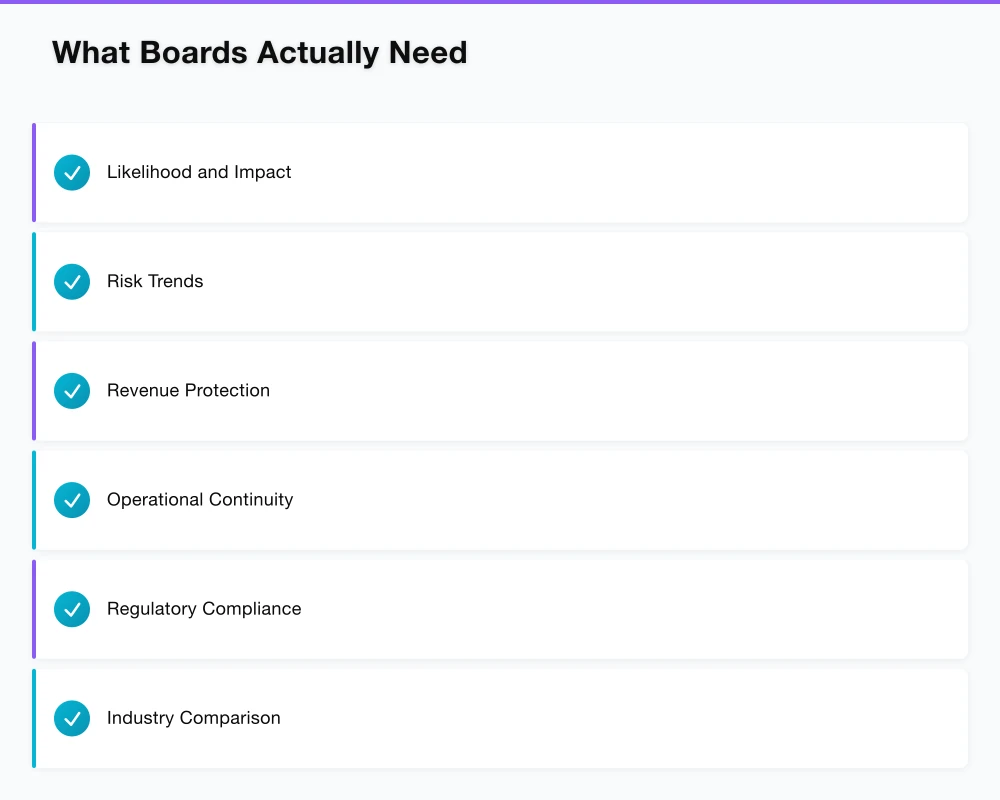
What Boards Actually Need
Risk-Based Framing
Boards understand risk. Frame cybersecurity in risk terms:
Likelihood and Impact
For significant risks, articulate:
- How likely is this to occur? (based on threat intelligence, industry trends)
- What would the business impact be? (revenue, reputation, regulatory, operational)
- What are we doing to reduce likelihood or impact?
- What residual risk remains?
Risk Trends
More valuable than point-in-time snapshots:
- Is our risk exposure increasing or decreasing?
- Are we keeping pace with threat evolution?
- How do new business initiatives affect risk?
Business Context
Connect security to business outcomes:
Revenue Protection
- Customer trust and retention
- Competitive differentiation
- Market access (especially regulated industries)
- Partnership and supply chain requirements
Operational Continuity
- System availability and reliability
- Recovery capabilities
- Business process resilience
- Supply chain security
Regulatory Compliance
- Current compliance status
- Upcoming regulatory changes
- Enforcement trends
- Compliance investment requirements
Peer Comparison
Boards benchmark everything. Provide context:
Industry Comparison
- How do we compare to industry peers?
- What do industry frameworks recommend?
- What are competitors investing?
Maturity Assessment
- Where are we on recognised maturity models?
- What’s our target maturity level?
- What investment is required to reach it?
Investment Effectiveness
Boards approve budgets. Show return:
Security Investment Trends
- What are we spending on security?
- How has investment changed over time?
- How does our investment compare to peers?
Outcome Metrics
- What has investment achieved?
- Are we measurably more secure?
- What incidents were prevented or contained?
Structuring Board Reports
Executive Summary
One page maximum. Cover:
- Overall Risk Posture: Current state in simple terms (improving/stable/declining)
- Key Changes: What’s different since last report
- Critical Items: Issues requiring board attention or decision
- Upcoming Priorities: Where focus is directed
Risk Dashboard
Visual representation of key risks:
Risk Heat Map
Plot significant cyber risks on likelihood/impact grid:
- Red: High likelihood, high impact (immediate attention)
- Amber: Elevated concern (monitoring, mitigation underway)
- Green: Managed to acceptable level
Trend Indicators
Show movement since last period:
- Improving (down arrow)
- Stable (horizontal)
- Worsening (up arrow)
Metrics That Matter
Select metrics that boards can interpret:
Good Board Metrics
Time-Based
- Mean time to detect threats
- Mean time to respond to incidents
- Time to patch critical vulnerabilities
Coverage-Based
- Percentage of systems with current protection
- Percentage of employees completing security training
- Third-party risk assessment coverage
Outcome-Based
- Security incidents by severity
- Successful vs blocked attacks
- Audit findings and remediation status
Metrics to Avoid
Technical Metrics Without Context
- Raw vulnerability counts (thousands mean nothing)
- Firewall blocks (millions are normal)
- Spam filtered (not actionable)
Vanity Metrics
- Compliance percentages without explanation
- Tool deployment counts
- Training completion without effectiveness
Incident Reporting
When incidents occur, boards need:
Immediate Notification (for significant incidents)
- What happened
- What’s the business impact
- What are we doing
- What do we need from the board
Post-Incident Review
- Root cause analysis
- Lessons learned
- Remediation actions
- Prevention measures
Trend Analysis
- Incident patterns over time
- Attack vector evolution
- Response effectiveness improvement
Investment Proposals
When requesting security investment:
Business Case Structure
- Risk being addressed
- Current state and gap
- Proposed investment
- Expected outcome
- Alternatives considered
- Recommendation
Avoid Technical Justification
Not: “We need a next-generation SIEM with machine learning capabilities”
Instead: “We currently take 4 hours on average to detect threats. Industry benchmark is 1 hour. This investment would reduce detection time to under 1 hour, limiting potential breach impact by an estimated 60%.”
Common Pitfalls
Technical Overload
Boards don’t need to understand:
- Specific vulnerabilities (CVE numbers)
- Attack technique details
- Tool architectures
- Protocol specifications
They need to understand business implications.
False Reassurance
Dangerous phrases:
- “We’re compliant” (compliance ≠ security)
- “We haven’t had any breaches” (that you know of)
- “Our tools are best-in-class” (tools don’t equal outcomes)
- “We’re 95% secure” (meaningless metric)
Crying Wolf
Every report highlighting critical emergencies:
- Desensitises the board
- Undermines credibility
- Makes genuine emergencies harder to communicate
- Suggests poor risk management
Calibrate urgency appropriately.
No Decision Framework
Reports that inform but don’t enable action:
- What decision is the board being asked to make?
- What information do they need to make it?
- What are the options and trade-offs?
- What do you recommend?
Ignoring Good News
Boards need balanced perspective:
- What’s working well
- Investments paying off
- Improvements achieved
- Risks successfully mitigated
Constant negativity undermines confidence and obscures priorities.
Practical Implementation
Reporting Cadence
Regular Reporting
Quarterly board reporting is typical:
- Sufficient frequency for oversight
- Allows meaningful trend analysis
- Doesn’t overwhelm board agenda
Exception Reporting
Immediate notification for:
- Significant security incidents
- Major regulatory changes
- Critical vulnerability discoveries
- Material third-party breaches
Preparation Process
Before Each Board Meeting
- Review previous report and commitments
- Gather updated metrics and data
- Identify significant changes and trends
- Prepare clear recommendations
- Anticipate questions
Board Member Engagement
Between meetings:
- Brief the board chair on emerging issues
- Offer education sessions for interested directors
- Provide relevant industry news and context
- Build relationships outside formal reporting
Building Board Capability
Boards vary in cyber sophistication. Help them:
Education
- Periodic briefings on threat landscape
- Industry incident case studies
- Regulatory development updates
- External expert sessions
Frameworks
Introduce recognised frameworks:
- NIST Cybersecurity Framework
- CIS Controls
- Industry-specific frameworks
- Maturity models
Benchmarking
Provide external reference points:
- Industry surveys and reports
- Peer comparison where available
- Analyst perspectives
Working with the Board
Know Your Audience
Different directors bring different perspectives:
- Former executives understand operational risk
- Financial backgrounds focus on quantification
- Legal backgrounds emphasise compliance and liability
- Technology backgrounds may want more detail
Tailor communication accordingly.
Build Trust Over Time
Effective board relationships develop through:
- Consistent, honest reporting
- Following through on commitments
- Acknowledging uncertainties
- Admitting mistakes when they occur
Leverage Board Expertise
Directors often have relevant experience:
- Crisis management from other contexts
- Risk governance approaches
- Industry connections and intelligence
- Strategic perspective
Don’t just report to the board—engage them as advisors.
Measuring Reporting Effectiveness
Board Engagement Indicators
- Questions asked during presentations
- Follow-up discussions requested
- Support for investment proposals
- Engagement between meetings
Decision Quality
- Appropriate risk acceptance decisions
- Timely investment approvals
- Clear accountability establishment
- Strategic alignment of security initiatives
Incident Response
When incidents occur:
- Board response is proportionate
- Communication flows appropriately
- Decisions are made effectively
- Relationships withstand pressure
Conclusion
Board reporting on cybersecurity is a strategic capability, not an administrative burden. CTOs and CISOs who communicate effectively secure resources, build organisational resilience, and establish security as a business enabler rather than a cost centre.
The key is translation: converting technical reality into business-relevant insight that enables informed governance decisions. Focus on risk, business context, trends, and actionable recommendations.
Boards don’t need to become technical experts. They need enough understanding to govern effectively. Your role is to provide that understanding clearly and consistently.
Sources
- NACD. (2023). Director’s Handbook on Cyber-Risk Oversight. National Association of Corporate Directors. https://www.nacdonline.org/cyber
- World Economic Forum. (2023). Principles for Board Governance of Cyber Risk. WEF. https://www.weforum.org/reports/principles-for-board-governance-of-cyber-risk
- CISA. (2023). Cyber Risk Oversight for Corporate Boards. Cybersecurity and Infrastructure Security Agency. https://www.cisa.gov/cyber-risk-oversight
- NIST. (2018). Framework for Improving Critical Infrastructure Cybersecurity. National Institute of Standards and Technology. https://www.nist.gov/cyberframework
Strategic guidance for technology leaders building effective board relationships.
If this strategic perspective has you thinking about cloud adoption, Cloud Geeks provides the implementation detail — from AWS setup to security hardening.
Ganda Tech Services is my technology consultancy, bringing together cloud infrastructure, web development, and mobile expertise for Australian businesses.
About the Author
Ashish Ganda is the founder of Ganda Tech Services, a Sydney-based technology consultancy specialising in cloud infrastructure, web development, and mobile app solutions for Australian businesses.
Digital Transformation Roadmap 2026
A 12-month framework for Australian SMBs ready to modernise — phases, tools, and milestones.
Almost done
Check your inbox and click the confirmation link to get your download.