Citation, Not Reach: Writing for AI Answers
There are now two audiences for anything you publish, and they reward different things.
The first is the feed. It rewards a strong opening, a reason to stop scrolling, an emotional hook, and a shape that invites a comment. Everything most content advice has said for a decade optimises for this audience.
The second is the set of systems that answer questions — ChatGPT, Copilot, Perplexity, Google’s AI results. They reward something close to the opposite: a clear factual claim, attributable, in a structure that can be lifted out of context and still hold.
LinkedIn puts it plainly in its own material on the subject: engagement metrics do not predict AI visibility. A post can perform badly in the feed and be cited repeatedly, or travel widely and never be quoted.
That is a strategy problem before it is a writing problem, because almost every content programme measures only the first audience.
What is actually changing
The mechanism is simple and the consequence is not. A buyer with a question increasingly gets an answer from an AI system and never lands on the source. LinkedIn’s framing of its own data is that website traffic is declining while buyers get their answers before reaching a brand’s site.
If that is true of your category, then the question stops being “did this travel?” and becomes “was this quoted?”
Those are measured differently, produced differently, and one of them is currently invisible in most reporting.
A caution on the evidence, since it matters: the strongest claims here are LinkedIn’s own, about LinkedIn — including its statement that it dominates AI search results across the major assistants. That is a platform describing its own value, which does not make it wrong and does mean it should be read as a position rather than as an independent finding. The structural argument stands regardless of whose platform benefits.
The metric that makes this look like failure
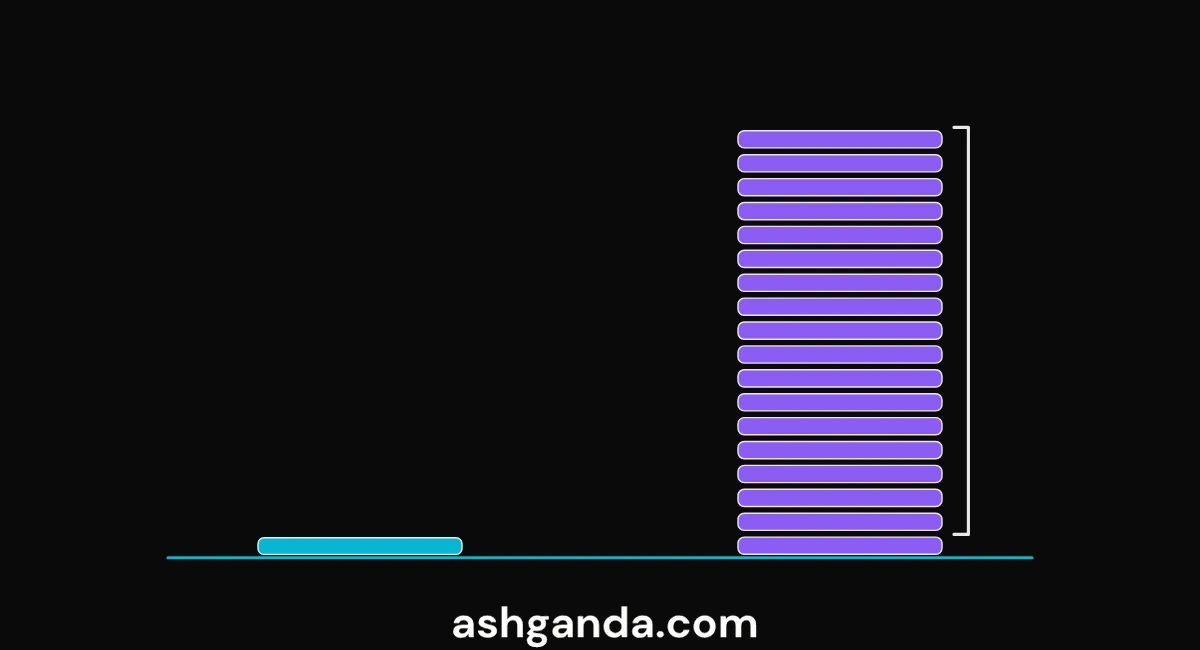
The single most useful number we have come across on this: the median time for a page to be cited by an AI model is 6.81 days, and 90% of pages take up to 37 days.
That is presented by LinkedIn from Profound’s data, and it explains a specific and expensive mistake.
A piece is published. It is measured at 48 hours, as everything is. It shows nothing. It is recorded as a failure, and the next brief moves toward whatever did perform at 48 hours — which is the format optimised for the first audience.
Meanwhile the piece was cited on day nine, to an audience that never appeared in any report.
A five-week lag measured on a two-day cycle produces a systematically wrong signal, and it pushes a content programme toward the exact format that citation does not reward. Nobody makes a bad decision; the measurement window makes it for them.
★ Insight ─────────────────────────────────────
This is the same structural error as judging a control by whether it has ever fired. In both cases the measurement is taken over a window in which the thing being measured cannot yet have happened, and the absence of a result is read as a result. The fix is identical too: decide what evidence would count before measuring, and give it long enough to exist.
─────────────────────────────────────────────────
What the second audience rewards
Four properties, and all four are at odds with conventional engagement advice.
A claim that survives removal from context. An AI answer quotes a sentence or a short passage without your surrounding argument. If your key point only makes sense after three paragraphs of setup, it cannot be lifted. The citable unit is a self-contained assertion.
Specificity that can be attributed. “Most businesses struggle with this” is unquotable. “1,205 notifiable breaches were reported in 2025, 59% attributed to malicious activity” is quotable, because it is a fact with a shape. Numbers, dates, named sources and stated scope are what make a passage usable.
Structure that signals what a passage is. Headings that name the question, direct answers near the top of a section, tables where the content is comparative. Not for aesthetics — because these make it mechanically clear which part of the page answers which question.
Boring, declarative sentences. The rhetorical devices that make a post travel — the cliffhanger, the deliberate incompleteness, the one-line paragraph that sets up the next — actively prevent citation, because each makes the sentence dependent on what follows.
What this does not mean
Three over-corrections worth avoiding, because the argument above is easy to take too far.
It does not mean abandoning the feed. The feed is where people discover that you exist, and citation without awareness produces mentions to an audience that has never heard of you. The two work together; only the measurement has to be separated.
It does not mean writing badly. “Citable” is not a licence for flat prose. The properties that make a passage quotable — specificity, self-containment, a clear claim — are also the properties of good expository writing. What changes is the removal of devices that create dependency between sentences, not the removal of craft.
It does not mean gaming anything. There is already an industry offering to engineer citations, and it will produce the same outcome as every previous optimisation industry: a short advantage, then a correction, then a penalty. The durable version is to be the source that is genuinely worth quoting on a question people actually ask.
Where to start, concretely
One change, this quarter: pick the three questions your customers ask most often, and write one piece per question that answers it in the first hundred words.
Not a piece that builds to the answer. One that states it, then explains it, then qualifies it. That structure is unusual enough in marketing content that doing it well is most of the advantage available.
Then leave them alone for six weeks before judging. On the latency figures above, anything shorter is measuring a period in which the result cannot yet exist.
The strategic decision
You cannot optimise a single piece for both audiences well. The honest move is to decide per piece, before writing, which one it is for.
Feed-first for announcements, commentary, anything time-bound, anything whose value is that people see you said it.
Citation-first for anything explaining how something works, comparing options, or establishing a number. This is where your expertise compounds, and the return arrives over weeks rather than hours.
The ratio depends on your business. For professional services and B2B — where buyers research at length and arrive already informed — the case for weighting toward citation is strong. For consumer brands where the purchase is impulsive, much less so.
Measuring the thing you cannot see directly
You cannot get a report of AI citations. Three imperfect proxies, in order of usefulness:
Ask the systems directly, on a schedule. Put your category’s real buying questions to the major assistants once a month and record whether you appear and how you are described. Crude, manual, and the only direct evidence available.
Watch for referral traffic from assistant domains. Small, growing, and present in analytics as a distinct source. Undercounts badly, because the whole point is that most people do not click.
Track branded search volume against content output. If your material is being quoted without attribution links, one visible effect is people later searching your name. A rise in branded search with flat direct traffic is consistent with being cited.
None of these is good. All of them beat the current default, which is measuring engagement at 48 hours and inferring everything else.
The uncomfortable implication
If citation matters in your category, then a meaningful share of your content’s value is realised by people who never visit your site, never enter your analytics, and never fill in a form.
That is genuinely difficult for organisations that judge marketing on attributable pipeline, and the honest response is not to pretend otherwise. It is to accept that some of the return has moved outside the attribution model — and to notice that a model which cannot see a channel will always recommend defunding it.
The businesses that get this right over the next few years will be the ones that decided what to publish on the basis of what is true and useful, rather than on what the 48-hour number rewarded.
Content strategy, AI citation and the measurement problems underneath both are part of the advisory work we do through Ganda Tech Services, with content operations through Cosmos Web Tech.
AI Strategy Primer for Australian Business Leaders
A practical framework for AI adoption in 2026 — cut through the hype and start with what matters.
Almost done
Check your inbox and click the confirmation link to get your download.