
API Design Patterns for Enterprise Microservices: Lessons from Production Systems
The Cost of Bad API Design
A poorly designed API creates debt that compounds over time. Every consumer that integrates with that API becomes invested in its quirks. Every new feature requires workarounds for past mistakes. Every breaking change requires coordinated deployments across teams that may not even work for your organisation anymore.
I’ve seen enterprise API landscapes where teams spend more time managing integration complexity than building features. Where “simple” changes require months of coordination. Where the fear of breaking something prevents any improvement.
Good API design prevents this. It creates interfaces that are intuitive to use, flexible to extend, and stable over time. It treats APIs as products with their own requirements, documentation, and evolution strategy.
This post examines the patterns that separate APIs teams want to integrate with from APIs teams dread.
Design Principles
Principle 1: Design for the Consumer
APIs exist to serve consumers, not to expose internal implementation. Yet the most common API design mistake is building interfaces that mirror database schemas or internal domain models.
Internal-Centric (Anti-pattern):
GET /customer_accounts
{
  "customer_account_id": 12345,
  "acct_type_cd": "PREM",
  "cust_id_fk": 67890,
  "status_cd": "A",
  "created_ts": "2024-01-15T10:30:00",
  "modified_ts": "2024-02-10T14:22:00"
}
This API leaks implementation details: database column naming conventions, foreign key references, internal status codes. Consumers must understand your schema to use your API.
Consumer-Centric:
GET /customers/67890/accounts/12345
{
  "id": "12345",
  "type": "premium",
  "status": "active",
  "createdAt": "2024-01-15T10:30:00Z",
  "updatedAt": "2024-02-10T14:22:00Z",
  "customer": {
    "id": "67890",
    "href": "/customers/67890"
  }
}
This API uses clear naming, meaningful values, and includes relationships consumers need. The internal implementation is invisible.
Principle 2: Consistency Above All
Inconsistent APIs create cognitive load. Developers must remember which patterns apply to which endpoints. Documentation becomes essential for every call rather than predictable from understanding one.
Consistency Dimensions:
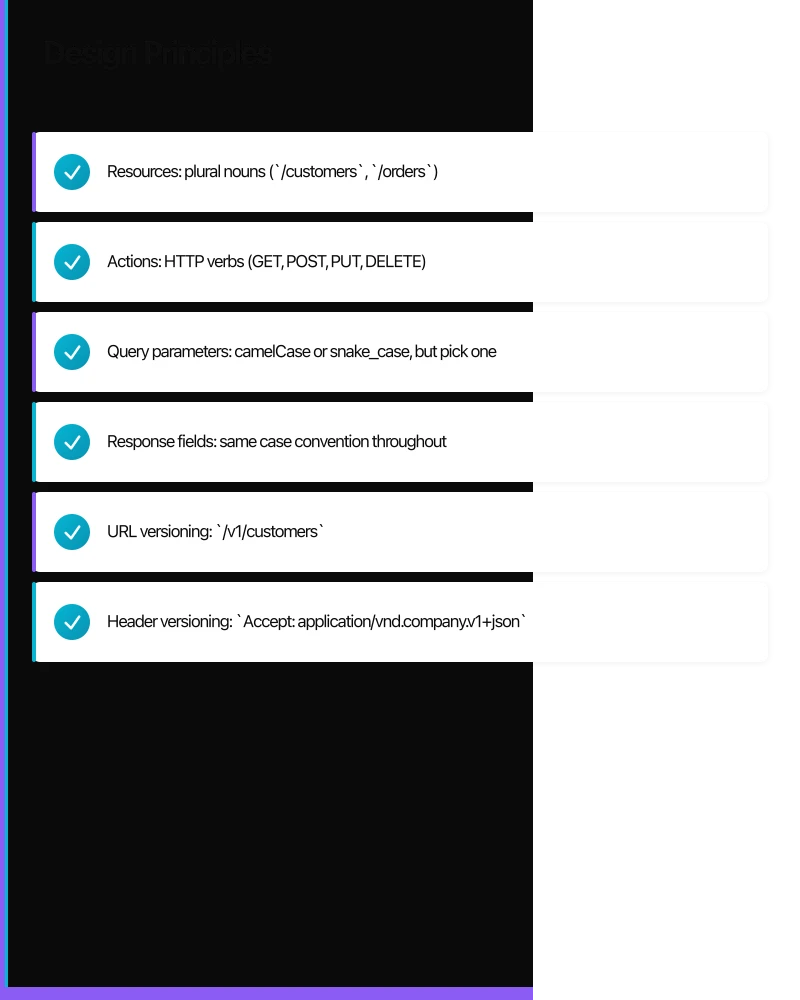
Naming:
- Resources: plural nouns (
/customers,/orders) - Actions: HTTP verbs (GET, POST, PUT, DELETE)
- Query parameters: camelCase or snake_case, but pick one
- Response fields: same case convention throughout
Resource Structure:
/resources                    # List
/resources/{id}               # Get single
/resources/{id}/subresources  # Related resources
Response Format:
{
  "data": { ... },           // Always present for success
  "meta": {                  // Pagination, totals
    "pagination": { ... }
  },
  "links": {                 // HATEOAS links
    "self": "...",
    "next": "..."
  }
}
Error Format:
{
  "error": {
    "code": "VALIDATION_ERROR",
    "message": "Request validation failed",
    "details": [
      {
        "field": "email",
        "message": "Invalid email format"
      }
    ]
  }
}
Principle 3: Evolvability Over Perfection
You will not get the API right the first time. Design for evolution.
Additive Changes Only: Add new fields, new endpoints, new optional parameters. Never remove or rename without versioning.
Version from Day One: Include version in URL or header:
- URL versioning:
/v1/customers - Header versioning:
Accept: application/vnd.company.v1+json
Deprecation Strategy: Communicate deprecation through headers and documentation long before removal:
Deprecation: true
Sunset: Sat, 31 Dec 2025 23:59:59 GMT
Link: </v2/customers>; rel="successor-version"
Resource Design Patterns
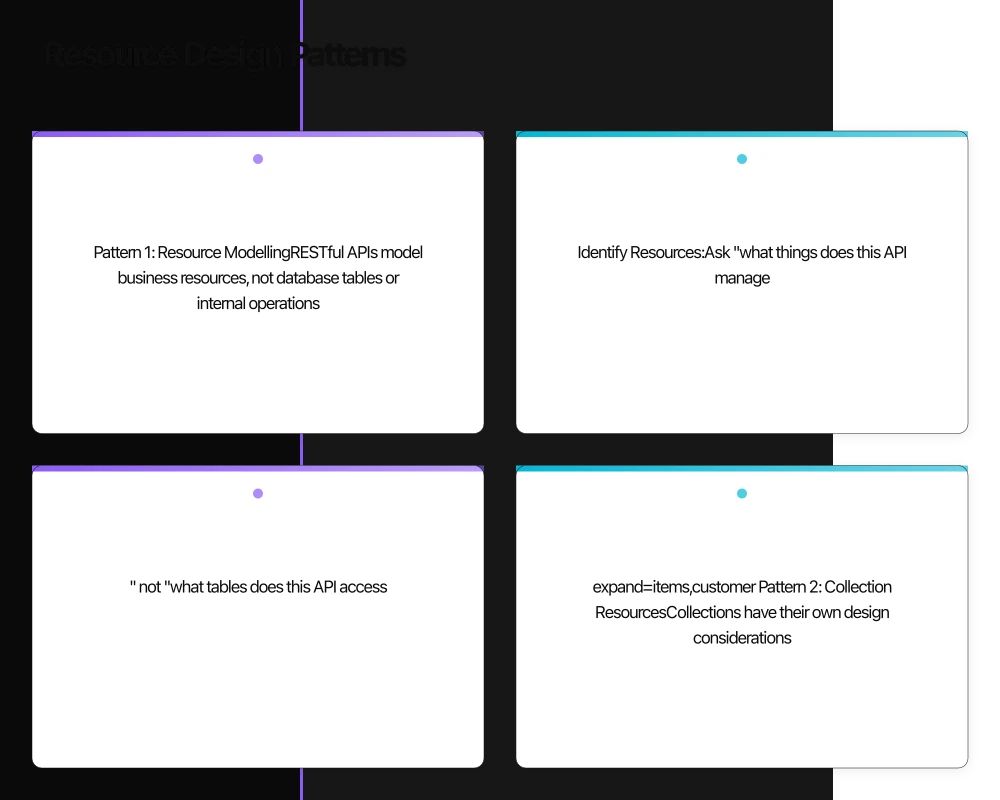
Pattern 1: Resource Modelling
RESTful APIs model business resources, not database tables or internal operations.
Identify Resources: Ask “what things does this API manage?” not “what tables does this API access?”
Example: Order Management
Poor: Mirrors database tables
/orders
/order_items
/order_status_history
/shipping_info
Better: Models business resources
/orders
/orders/{id}
/orders/{id}/items
/orders/{id}/shipments
/orders/{id}/timeline
Resource Relationships:
Embedded: Include related data in response
GET /orders/123
{
  "id": "123",
  "items": [
    { "productId": "456", "quantity": 2 }
  ]
}
Linked: Reference related resources
GET /orders/123
{
  "id": "123",
  "links": {
    "items": "/orders/123/items",
    "customer": "/customers/789"
  }
}
Expanded: Consumer controls embedding
GET /orders/123?expand=items,customerPattern 2: Collection Resources
Collections have their own design considerations.
Pagination: Never return unbounded collections. Implement pagination from day one.
Offset-based (simple, limited scale):
GET /orders?offset=0&limit=20Cursor-based (scalable, consistent):
GET /orders?cursor=eyJpZCI6MTIzfQ&limit=20Response includes next cursor:
{
  "data": [...],
  "meta": {
    "pagination": {
      "cursor": "eyJpZCI6MTQzfQ",
      "hasMore": true
    }
  },
  "links": {
    "next": "/orders?cursor=eyJpZCI6MTQzfQ&limit=20"
  }
}
Filtering: Standard approach for common filters:
GET /orders?status=pending&customerId=123Complex filtering with filter parameter:
GET /orders?filter=status:pending,createdAt:>2024-01-01Sorting:
GET /orders?sort=createdAt:desc,total:ascField Selection: Allow consumers to request only needed fields:
GET /orders?fields=id,status,totalPattern 3: Actions on Resources
Not everything maps cleanly to CRUD. Some operations are actions.
Action as Sub-resource:
POST /orders/123/cancel
POST /orders/123/ship
POST /accounts/456/suspend
Action with Request Body:
POST /orders/123/refund
{
  "amount": 50.00,
  "reason": "Customer request"
}
Avoid:
POST /cancel-order?orderId=123  # RPC-style, not RESTful
PUT /orders/123/status  # Status change may have side effects
Data Patterns
Pattern 1: Request Validation
Validate thoroughly; respond helpfully.
Validation Response:
{
  "error": {
    "code": "VALIDATION_ERROR",
    "message": "Request validation failed",
    "details": [
      {
        "field": "email",
        "code": "INVALID_FORMAT",
        "message": "Must be a valid email address"
      },
      {
        "field": "quantity",
        "code": "OUT_OF_RANGE",
        "message": "Must be between 1 and 100"
      }
    ]
  }
}
Validation Layers:
- Schema validation: correct types, required fields
- Format validation: email format, date format
- Business validation: inventory availability, account status
Return all validation errors at once; don’t make consumers fix one error at a time.
Pattern 2: Partial Updates
Full resource replacement (PUT) is often impractical. Support partial updates.
JSON Merge Patch (RFC 7396):
PATCH /customers/123
Content-Type: application/merge-patch+json

{
  "email": "[email protected]"
}
Simple but limited: can’t explicitly null fields (null means remove).
JSON Patch (RFC 6902):
PATCH /customers/123
Content-Type: application/json-patch+json

[
  { "op": "replace", "path": "/email", "value": "[email protected]" },
  { "op": "remove", "path": "/middleName" }
]
More powerful but more complex.
Pattern 3: Bulk Operations
Sometimes consumers need to operate on multiple resources.
Batch Endpoint:
POST /orders/batch
{
  "operations": [
    { "method": "POST", "path": "/orders", "body": {...} },
    { "method": "PATCH", "path": "/orders/123", "body": {...} },
    { "method": "DELETE", "path": "/orders/456" }
  ]
}
Response includes per-operation results:
{
  "results": [
    { "status": 201, "body": {...} },
    { "status": 200, "body": {...} },
    { "status": 204 }
  ]
}
Bulk Create:
POST /orders/bulk
{
  "orders": [
    {...},
    {...}
  ]
}
Important: Define clear semantics for partial failure. All-or-nothing? Best-effort?
Error Handling Patterns
Error Response Structure
Errors should be:
- Machine-readable: error codes for programmatic handling
- Human-readable: messages for debugging
- Actionable: what can the consumer do?
{
  "error": {
    "code": "INSUFFICIENT_FUNDS",
    "message": "Account balance is insufficient for this transaction",
    "details": {
      "required": 150.00,
      "available": 75.50
    },
    "documentation": "https://docs.example.com/errors/INSUFFICIENT_FUNDS"
  }
}
HTTP Status Codes
Use status codes correctly:
2xx Success:
- 200: Success with body
- 201: Created (return created resource)
- 202: Accepted (async processing started)
- 204: Success, no content
4xx Client Errors:
- 400: Bad request (validation failure)
- 401: Unauthenticated
- 403: Forbidden (authenticated but not authorised)
- 404: Not found
- 409: Conflict (e.g., version mismatch)
- 422: Unprocessable entity (valid syntax, invalid semantics)
- 429: Too many requests (rate limited)
5xx Server Errors:
- 500: Internal server error
- 502: Bad gateway
- 503: Service unavailable (temporary)
- 504: Gateway timeout
Error Categories
Design error codes around categories:
VALIDATION_*    - Request validation errors
AUTH_*          - Authentication/authorisation errors
RESOURCE_*      - Resource state errors
BUSINESS_*      - Business rule violations
SYSTEM_*        - Internal system errors
This helps consumers implement error handling logic:
if (error.code.startsWith('VALIDATION_')) {
  showFormErrors(error.details);
} else if (error.code.startsWith('AUTH_')) {
  redirectToLogin();
} else {
  showGenericError();
}
Authentication and Authorisation
Authentication Patterns
API Keys: Simple, suitable for server-to-server.
Authorization: ApiKey abc123Limitations: no expiration, difficult to rotate, no user identity.
OAuth 2.0 / JWT: Standard for user-context APIs.
Authorization: Bearer eyJhbGciOiJSUzI1NiIs...JWT contains claims; server validates signature without database lookup.
Mutual TLS: Certificate-based authentication for high-security scenarios.
Authorisation Patterns
Scope-Based: Token includes scopes; API checks required scopes:
Token scopes: ["read:orders", "write:orders"]

GET /orders    # Requires read:orders
POST /orders   # Requires write:orders
Resource-Based: Check permissions against specific resources:
Can user 123 read order 456?
Can user 123 write order 456?
Attribute-Based (ABAC): Complex policies considering multiple attributes:
Allow if:
  user.department == resource.owner_department AND
  user.role in ["manager", "admin"] AND
  resource.status != "sealed"
Performance Patterns
Pattern 1: Caching
HTTP caching reduces load and improves response times.
Cache-Control Headers:
Cache-Control: max-age=3600, private
ETag: "abc123"
Last-Modified: Wed, 15 Feb 2024 10:30:00 GMT
Conditional Requests:
GET /products/123
If-None-Match: "abc123"

# Response if unchanged:
304 Not Modified
Cache Invalidation: The hard problem. Options:
- Short TTLs (simple but less effective)
- Event-driven invalidation (complex but precise)
- Stale-while-revalidate (balance)
Pattern 2: Compression
Compress responses for bandwidth efficiency:
Accept-Encoding: gzip, deflate
Content-Encoding: gzip
Pattern 3: Connection Management
Keep-Alive: Reuse TCP connections:
Connection: keep-aliveHTTP/2: Multiplexed requests over single connection. Significant improvement for APIs making many small requests.
Pattern 4: Rate Limiting
Protect APIs from abuse and ensure fair usage:
Response Headers:
X-RateLimit-Limit: 1000
X-RateLimit-Remaining: 750
X-RateLimit-Reset: 1707984000
When Limited:
HTTP/1.1 429 Too Many Requests
Retry-After: 60
Rate Limit Strategies:
- Fixed window: X requests per minute
- Sliding window: X requests in any 60-second period
- Token bucket: burst capacity with steady refill
Documentation and Discovery
API Documentation
Documentation is part of the API product.
OpenAPI Specification: Machine-readable API definition:
openapi: 3.1.0
info:
  title: Orders API
  version: 1.0.0
paths:
  /orders:
    get:
      summary: List orders
      parameters:
        - name: status
          in: query
          schema:
            type: string
            enum: [pending, shipped, delivered]
      responses:
        '200':
          description: List of orders
          content:
            application/json:
              schema:
                $ref: '#/components/schemas/OrderList'
Benefits:
- Auto-generated documentation
- Client SDK generation
- Request validation
- Testing tools
Documentation Content:
- Quick start guide
- Authentication setup
- Common use cases with examples
- Error reference
- Changelog and migration guides
API Discovery
For large API portfolios, help developers find what they need:
API Catalogue: Central registry of all APIs with:
- Description and purpose
- Owner and contact
- Documentation links
- Health status
Well-Known Endpoints:
GET /.well-known/api-catalog
{
  "apis": [
    {
      "name": "Orders API",
      "spec": "/openapi.yaml",
      "docs": "/docs"
    }
  ]
}
Versioning Strategies
When to Version
Version when making breaking changes:
- Removing fields or endpoints
- Changing field types
- Changing semantic meaning
- Modifying required fields
Don’t version for:
- Adding optional fields
- Adding new endpoints
- Adding new optional parameters
Versioning Approaches
URL Path Versioning:
/v1/orders
/v2/orders
Clear, simple, cacheable. Some argue it violates REST principles (same resource, different URLs).
Header Versioning:
Accept: application/vnd.company.v2+jsonCleaner URLs but harder to test in browser.
Query Parameter:
/orders?version=2Simple but pollutes query strings.
Version Lifecycle
- Current: Active development, full support
- Supported: No new features, security/bug fixes only
- Deprecated: Announced sunset date, migration guidance
- Retired: No longer available
Communicate lifecycle status clearly:
X-API-Version: 1
X-API-Deprecated: true
X-API-Sunset: 2025-06-01
Testing Patterns
Contract Testing
Ensure API contract is maintained:
// Consumer contract test
describe('Orders API', () => {
  it('returns order with expected structure', async () => {
    const order = await api.get('/orders/123');
    expect(order).toMatchSchema(orderSchema);
  });
});
Pact/Contract Testing: Consumer defines expectations; provider verifies against them. Catches breaking changes before deployment.
Integration Testing
Test against running API:
describe('Orders Integration', () => {
  it('creates and retrieves order', async () => {
    const created = await api.post('/orders', orderData);
    expect(created.status).toBe(201);

    const retrieved = await api.get(`/orders/${created.data.id}`);
    expect(retrieved.data).toMatchObject(orderData);
  });
});
Performance Testing
Establish and monitor baselines:
performance_requirements:
  /orders:
    p50_latency: 50ms
    p99_latency: 200ms
    throughput: 1000/s
Operational Considerations
Observability
APIs need comprehensive observability:
Logging:
- Request/response (sampling for volume)
- Error details
- Performance metrics
Metrics:
- Request rate by endpoint
- Error rate by type
- Latency distributions
- Active connections
Tracing:
- Request trace IDs across services
- Correlation with downstream calls
Health Checks
GET /health
{
  "status": "healthy",
  "checks": {
    "database": "healthy",
    "cache": "healthy",
    "downstream_service": "degraded"
  }
}
Use for load balancer health checks and monitoring.
Graceful Degradation
When dependencies fail:
- Return cached data with freshness indicator
- Exclude failed features from response
- Return partial success for batch operations
X-Degraded: cache=stale, recommendations=unavailableBuilding API Culture
Good APIs don’t happen by accident. They require:
Design Reviews: Peer review of API designs before implementation Style Guides: Documented conventions that all teams follow Shared Tooling: Common libraries, templates, and generators API Governance: Standards enforcement and quality gates
The organisations with the best APIs treat them as products. They have owners who care about consumer experience. They measure adoption and satisfaction. They invest in documentation and developer experience.
That investment pays dividends in reduced integration friction, faster partner onboarding, and systems that remain maintainable as they grow.
Ash Ganda advises enterprise technology leaders on API strategy, microservices architecture, and digital transformation. Connect on LinkedIn for ongoing insights.
Your digital strategy starts with being found online. Cosmos Web Tech covers SEO, WordPress, and web performance for Australian businesses.
I lead Ganda Tech Services, where we turn digital strategy into results through specialist cloud, web design, and mobile app teams across Sydney.
About the Author
Ashish Ganda is the founder of Ganda Tech Services, a Sydney-based technology consultancy specialising in cloud infrastructure, web development, and mobile app solutions for Australian businesses.
Digital Transformation Roadmap 2026
A 12-month framework for Australian SMBs ready to modernise — phases, tools, and milestones.
Almost done
Check your inbox and click the confirmation link to get your download.