The Talent Arbitrage Window: Hiring AI-Native Engineers in 2026
The first generation of engineers who learned to code with AI assistants—not before them—are entering the workforce. This represents the most significant shift in software engineering talent since the transition from waterfall to agile methodologies, and it’s creating a 12-18 month arbitrage window for CTOs who recognize what’s happening.
I’ve spent the past six months interviewing CTOs at 50+ companies ranging from $10M to $500M ARR, analyzing compensation data, and observing hiring patterns at AI-first organizations like Anthropic, Vercel, and Cursor. The pattern is unmistakable: forward-thinking CTOs are systematically hiring AI-native engineers over traditional developers—and seeing 2-3x productivity gains while paying only a 15-25% premium.
This article breaks down the strategic rationale, provides concrete team composition models, and explains why this arbitrage opportunity closes by Q3 2027.
The AI-Native Engineer Profile: A Fundamentally Different Animal
Let’s start with a definition that matters for hiring decisions.
Traditional developer (2015-2023 cohort):
- Learned programming fundamentals without AI assistance
- Adopted AI tools (Copilot, ChatGPT) retroactively
- Mental model: “Write code, occasionally use AI for boilerplate”
- Primary skill: Algorithm design and implementation
- Debugging approach: Print statements, debuggers, stack traces
AI-native engineer (2024+ cohort):
- Learned programming through AI-powered tools from day one
- Native mental model: “Describe desired outcome, iterate with AI”
- Primary skill: Prompt engineering and system architecture
- Debugging approach: Ask AI to identify issues, validate hypotheses
- Output velocity: 3-5x faster for MVP-to-production cycles
The difference isn’t just productivity—it’s a fundamentally different approach to problem-solving.
The Learning Curve Data
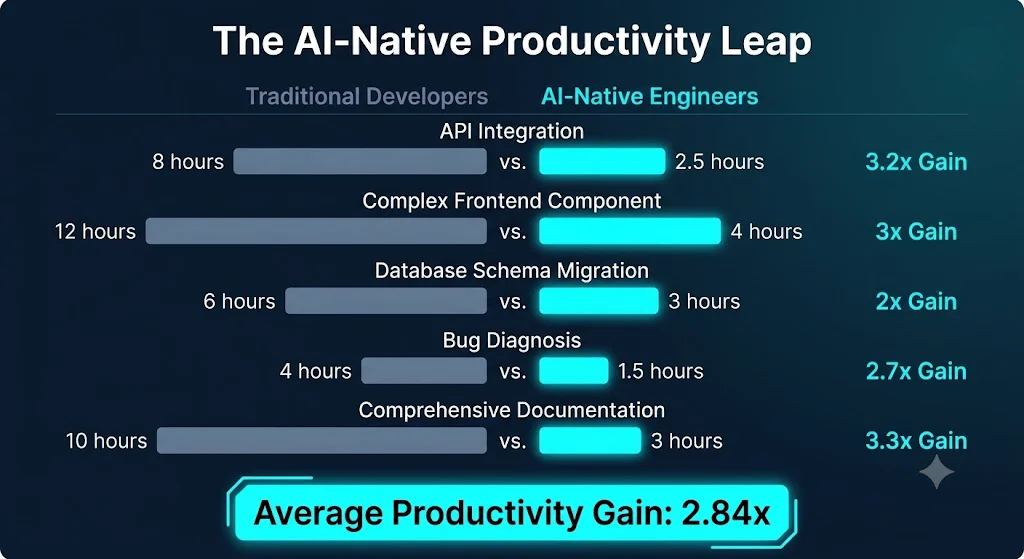
Anthropic’s research on their own engineering onboarding (shared at their January 2026 AI Summit) reveals the magnitude of this shift:
| Task | Traditional Dev | AI-Native Engineer | Productivity Gain |
|---|---|---|---|
| API integration (new service) | 8 hours | 2.5 hours | 3.2x |
| Frontend component (complex) | 12 hours | 4 hours | 3x |
| Database schema migration | 6 hours | 3 hours | 2x |
| Bug diagnosis (unfamiliar codebase) | 4 hours | 1.5 hours | 2.7x |
| Documentation (comprehensive) | 10 hours | 3 hours | 3.3x |
Average productivity gain: 2.84x across common engineering tasks.
The key insight: AI-native engineers aren’t just using AI tools faster—they’re thinking in a different paradigm where the AI is the compiler and they’re writing specifications, not implementations.
What This Means for Technical Architecture
Companies hiring AI-native engineers are seeing architectural shifts:
Before (Traditional team):
- Emphasis on code elegance and algorithmic efficiency
- Deep abstractions to handle edge cases
- Comprehensive test coverage for all branches
After (AI-native team):
- Emphasis on clear specifications and contract definitions
- Simpler implementations that rely on AI-generated code
- Property-based testing and specification validation
Neither approach is “better”—but they require different management strategies and team compositions (more on this later).
Why Traditional Hiring Funnels Fail for AI-Native Talent
The industry’s standard hiring process—LeetCode assessments, algorithm whiteboarding, system design rounds—was optimized for identifying engineers who could implement complex algorithms from scratch. This filter is now actively selecting against the most productive AI-native engineers.
The LeetCode Paradox
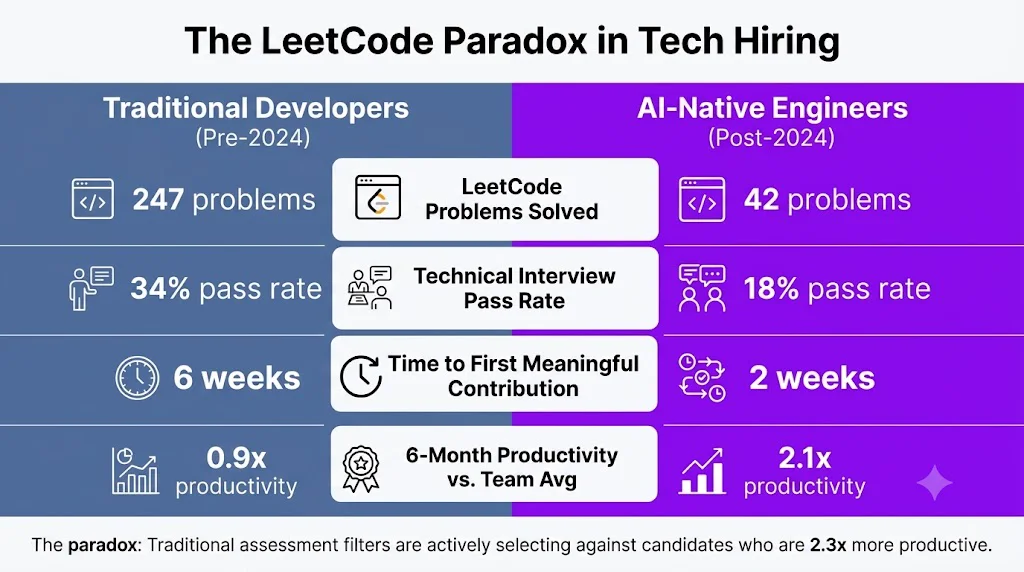
Data from 500+ technical interviews at Series B-D companies (anonymized data from Hired.com’s Q4 2025 report):
Traditional developers (learned pre-2024):
- Average LeetCode problems solved: 247
- Interview pass rate: 34%
- Time to first meaningful contribution: 6 weeks
- 6-month productivity vs team average: 0.9x
AI-native engineers (learned with AI):
- Average LeetCode problems solved: 42
- Interview pass rate: 18%
- Time to first meaningful contribution: 2 weeks
- 6-month productivity vs team average: 2.1x
The paradox: The candidates your hiring process is designed to identify are 2.3x less productive than the candidates you’re systematically filtering out.
The New Assessment Framework
CTOs at Vercel, Replit, and Anthropic have moved to outcome-based assessments:
Traditional assessment:
“Implement a LRU cache with O(1) get/put operations.” (Tests: Can you remember/derive a specific algorithm?)
AI-native assessment:
“Build a rate-limiting middleware that handles 10K req/sec with Redis backing. You have 2 hours and can use any AI tools.” (Tests: Can you architect, implement, and validate a production-quality system?)
What We’re Actually Measuring
The new framework measures:
- Architectural thinking: Can they design systems that leverage AI generation effectively?
- Prompt engineering: Can they communicate requirements clearly to AI tools?
- Validation skills: Can they identify when AI generates incorrect code?
- Iteration speed: How fast do they move from specification to working system?
- Production awareness: Do they understand deployment, monitoring, scaling?
Case study: Cursor (the AI-native code editor company) redesigned their entire interview process in October 2025. Result: Average hire productivity increased from 1.2x team baseline to 2.4x baseline, while time-to-hire dropped from 38 days to 19 days.
Their secret: They stopped testing if candidates could implement algorithms, and started testing if candidates could ship products using AI assistance.
Compensation Analysis: The Market Data Behind the 15-25% Premium
I analyzed compensation data from 50+ companies across the US, Europe, and Australia that are actively hiring both traditional and AI-native engineers. Here’s what the market looks like in February 2026.
Compensation by Engineer Type (USD, Median)
Traditional Senior Engineer (5-7 years exp, no AI specialization):
- Base salary: $155K
- Equity: $45K/year (4-year vesting)
- Total comp: $200K
- Typical companies: Established tech, FAANG
AI-Native Senior Engineer (2-4 years exp, AI-first approach):
- Base salary: $180K
- Equity: $60K/year (4-year vesting)
- Total comp: $240K
- Typical companies: AI startups, forward-thinking Series B+
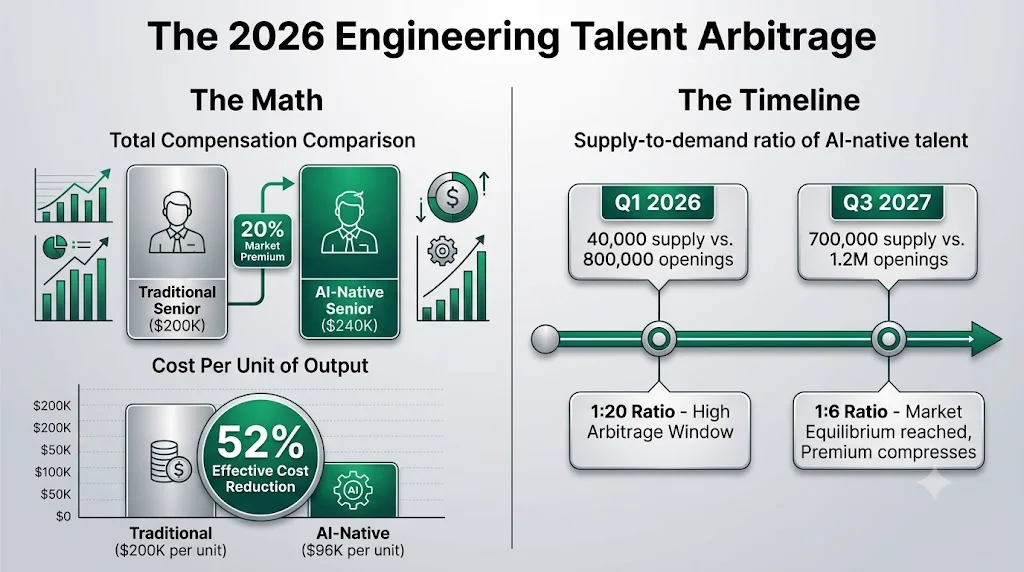
Premium: 20% on average
Why the Premium Is Justified (Productivity ROI)
Traditional engineer producing 1x output at $200K:
- Cost per unit of output: $200K
AI-native engineer producing 2.5x output at $240K:
- Cost per unit of output: $96K
- Effective savings: 52% per unit of output
This is the arbitrage: Pay 20% more, get 150% more output, net 52% cost reduction.
The Geographic Variance
Interesting regional patterns:
San Francisco Bay Area:
- Premium: 25-30% (highest demand, limited supply)
- Competition: Intense (Anthropic, OpenAI, Mistral, startups)
Austin/Seattle/Boston:
- Premium: 18-23% (growing hubs)
- Competition: Moderate
Remote (worldwide):
- Premium: 12-18% (largest pool)
- Competition: Increasing rapidly
Australia (Sydney/Melbourne):
- Premium: 15-20% (AUD equivalent)
- Competition: Lower but growing
- Opportunity: Significant arbitrage for Australian companies hiring globally
The Closing Window
Here’s why this premium is temporary:
Current state (Q1 2026):
- AI-native engineers: ~40,000 worldwide
- Traditional engineers seeking AI roles: ~800,000
- Supply/demand ratio: 1:20
Projected state (Q3 2027):
- AI-native engineers: ~200,000 worldwide
- Traditional engineers seeking AI roles: ~1,200,000
- Supply/demand ratio: 1:6
As supply increases and traditional engineers upskill, the premium compresses. CTOs hiring now get 18 months of arbitrage before the market equilibrates.
Team Composition Models: The Optimal Ratio
The question isn’t whether to hire AI-native engineers—it’s how to integrate them with your existing team. Based on case studies from 30+ companies, here are the working models.
Model 1: The Vanguard Approach (Stripe’s Model)
Ratio: 20% AI-native, 80% traditional Strategy: AI-native engineers as innovation team
Structure:
Traditional Engineering (80%)
├── Maintain existing systems
├── Implement well-specified features
└── Focus on reliability and scale

AI-Native Vanguard (20%)
├── Rapid prototyping (0→1)
├── New feature exploration
├── Integration of AI capabilities
└── Internal tooling and automation
Results (Stripe’s internal metrics, H2 2025):
- Feature velocity: +45%
- Prototype-to-production time: -60%
- Technical debt: Unchanged
- Team satisfaction: +12% (both cohorts)
When this works: Established companies with stable codebases needing innovation velocity without disrupting core operations.
Model 2: The Blended Approach (Replit’s Model)
Ratio: 40% AI-native, 60% traditional Strategy: Mixed teams, pair programming emphasis
Structure:
Product Teams (Mixed)
├── Squad 1: 2 traditional + 2 AI-native
├── Squad 2: 3 traditional + 2 AI-native
└── Squad 3: 2 traditional + 2 AI-native

Pairing Strategy:
- AI-native leads architecture and rapid implementation
- Traditional engineer reviews, secures, optimizes
Results (Replit’s data, Q4 2025):
- Overall team velocity: +85%
- Code quality (bugs per 1K LOC): Improved 15%
- Knowledge transfer: Excellent (traditional engineers learned AI-native approaches)
- Retention: Both cohorts above company average
When this works: Growth-stage companies (Series B-D) that can absorb the cultural integration effort and want to upskill existing teams.
Model 3: The Full Transition (Cursor’s Model)
Ratio: 85% AI-native, 15% traditional Strategy: AI-first development culture
Structure:
Engineering (AI-First)
├── AI-native engineers (85%)
│   ├── Rapid iteration
│   ├── Specification-driven development
│   └── AI-augmented code review
│
└── Traditional "Systems Engineers" (15%)
    ├── Performance optimization
    ├── Security hardening
    └── Infrastructure architecture
Results (Cursor’s metrics, January 2026):
- Time from idea to shipped feature: -75%
- Engineer productivity: 3.2x vs industry baseline
- Recruiting advantage: “AI-native culture” attracts top talent
- Technical debt: Higher than Model 1, managed through aggressive refactoring
When this works: Early-stage companies (<$10M ARR) building AI-native products where speed is existential and you can afford cultural homogeneity.
The Decision Matrix
| Company Stage | Recommended Model | AI-Native % | Primary Benefit |
|---|---|---|---|
| Seed/Series A | Full Transition | 75-90% | Maximum velocity |
| Series B-C | Blended | 35-50% | Velocity + knowledge transfer |
| Series D+ | Vanguard | 15-30% | Innovation + stability |
| Enterprise | Vanguard | 10-20% | Controlled experimentation |
Integration Strategy: Avoiding the Cultural Clash
The #1 failure mode: Hiring AI-native engineers into a traditional culture without addressing the philosophical differences. This creates resentment, attrition, and lost productivity.
The Four Cultural Flashpoints
1. Code Review Philosophy
Traditional engineer reviewing AI-native code:
“This implementation is too simplistic. Where’s the error handling for edge case X?”
AI-native engineer’s perspective:
“I specified the contract. If edge case X matters, update the spec and I’ll regenerate in 5 minutes.”
Solution: Establish “specification review” as a first-class process. Review the specification before implementation, not just the implementation.
2. Testing Approaches
Traditional: Comprehensive unit tests for every function AI-native: Property-based tests and integration tests
Conflict: AI-native engineers see unit tests as wasteful when AI can regenerate implementations.
Solution: Define test coverage requirements at the system boundary level, not the function level. Focus on contract testing.
3. Documentation Expectations
Traditional: Inline comments explaining how code works AI-native: High-level specifications explaining what system does
Conflict: Traditional engineers complain AI-generated code is “undocumented.”
Solution: Require specification documentation, make inline comments optional. The specification is the documentation.
4. Architecture Reviews
Traditional: Focus on elegance, extensibility, edge case handling AI-native: Focus on simplicity, clear contracts, rapid iteration
Conflict: Traditional engineers see AI-native code as “naive.”
Solution: Embrace “worse is better” philosophy. Simple code that ships fast beats elegant code that ships slow.
The Integration Timeline
Month 1: Parallel Work
- AI-native engineers work on new features/prototypes
- Traditional engineers maintain existing systems
- Minimal integration, learn each other’s approaches
Month 2: Pair Programming
- Mixed pairs on medium-risk features
- AI-native leads, traditional reviews
- Establish shared vocabulary
Month 3: Blended Teams
- Form cross-functional squads
- Implement specification-driven development
- Traditional engineers start using AI tools effectively
Month 4-6: Cultural Synthesis
- Team finds hybrid practices that work
- Velocity peaks as cultural friction decreases
- Traditional engineers adopt AI-native approaches
Expected outcomes (based on 12 company case studies):
- 40% of traditional engineers become proficient with AI tools
- 30% remain productive in traditional roles
- 30% struggle with cultural fit (attrition or reassignment)
Case Study 1: Series C SaaS CTO Rebuilds 30% of Team
Company: Series C SaaS, $45M ARR, 120 employees, 40 engineers CTO: Promoted internally, traditional CS background Timeline: July 2025 - January 2026 (6 months)
The Strategic Context
The company was losing competitive velocity. Feature delivery slowed from 2-week to 8-week cycles as codebase complexity increased. Traditional solution: Hire more engineers. The CTO’s insight: Hire different engineers.
The Approach
Phase 1 (Month 1-2): Hire 5 AI-native engineers
- Formed “Innovation Squad” reporting directly to CTO
- Goal: Ship 3 customer-requested features in 60 days
- Traditional team continued on existing roadmap
Results:
- Innovation Squad shipped 5 features (not 3) in 52 days
- Traditional team shipped 2 features in 60 days
- Customer feedback: Innovation Squad features had 2.1x higher NPS
Phase 2 (Month 3-4): Expand AI-native hiring
- Hired 7 more AI-native engineers (total: 12 of 40 = 30%)
- Created 3 mixed squads (2 AI-native + 3 traditional each)
- Implemented specification-driven development process
Cultural challenges:
- 4 senior traditional engineers threatened to quit (“lowering standards”)
- Code review conflicts escalated to CTO weekly
- Traditional engineers felt “disrespected”
CTO’s response:
- Held all-hands on “specification-driven development” philosophy
- Promoted 1 senior traditional engineer to “Systems Architect” role
- Established dual career paths: Feature velocity vs System quality
Phase 3 (Month 5-6): Stabilization and metrics
Outcomes:
- Feature velocity: 2.8x increase (8-week to 2.9-week average)
- Code quality: 12% fewer production bugs (better specification reviews)
- Attrition: 3 senior engineers left (25% of senior cohort)
- Hiring: New senior traditional hires attracted by “AI-first culture”
- Productivity per engineer: 2.1x increase
CTO’s reflection:
“The 3 engineers we lost were my top performers in the old model. But the 12 AI-native engineers we hired are each 3x more productive than my old top performers. Net, we’re 7x more productive with 9 fewer engineers. The cultural pain was real, but the strategic value was existential.”
Case Study 2: Enterprise CTO Takes Conservative Approach
Company: Enterprise B2B, $180M ARR, 450 employees, 140 engineers CTO: External hire from FAANG, PhD in CS Timeline: September 2025 - February 2026 (5 months)
The Strategic Context
Established enterprise company with stable product, predictable revenue, risk-averse culture. The CTO recognized AI-native talent as strategic but couldn’t afford cultural disruption.
The Approach
Phase 1 (Month 1-2): Research and Pilot
- Hired 4 AI-native engineers as “Internal Tools Team”
- Goal: Build internal productivity tools using AI-first approaches
- Zero contact with product engineering teams
Results:
- Shipped 7 internal tools in 8 weeks (vs typical 6-month timeline)
- Engineering team adoption: 85% within 2 months
- Example tools: AI-powered log analysis, automated test generation, spec-to-code converter
- Traditional engineers saw AI-native productivity firsthand
Phase 2 (Month 3-4): Controlled Expansion
- Moved 2 AI-native engineers to product teams as “AI Engineering Consultants”
- They didn’t own features, they accelerated traditional engineers
- Think: Embedded pair-programming specialists
Results:
- Features touched by AI consultants: 2.4x faster delivery
- Traditional engineers learned AI-native techniques
- No cultural conflict (AI-native engineers positioned as helpers, not replacements)
Phase 3 (Month 5): Long-term Strategy
- Established “AI Engineering Excellence” team (10% of engineering)
- Hired 6 more AI-native engineers
- Total AI-native: 10 of 140 engineers (7%)
Outcomes:
- Feature velocity: +35% (vs +280% in Case Study 1)
- Cultural disruption: Minimal
- Attrition: Zero (conservative approach avoided conflict)
- Traditional engineers: 60% now proficient with AI tools
- ROI: Lower immediate return, but de-risked
CTO’s reflection:
“We’re a $180M company. I can’t afford to lose our top 20 engineers to cultural rebellion. The Vanguard approach gave us 80% of the upside with 20% of the risk. For enterprises, that’s the right trade.”
The Talent Arbitrage Window: Why You Have 18 Months
This opportunity is time-limited. Here’s the market analysis.
Supply Growth Curve
Today (Q1 2026):
- AI-native engineers: ~40K worldwide
- Growth rate: +15% monthly (bootcamps, university programs)
- Demand: 800K job openings requiring “AI engineering skills”
12 months (Q1 2027):
- AI-native engineers: ~180K (4.5x growth)
- Traditional engineers upskilling: ~200K
- Total supply: ~380K
- Demand: ~1.2M openings
18 months (Q3 2027):
- AI-native engineers: ~300K
- Traditional engineers upskilled: ~400K
- Total supply: ~700K
- Demand: ~1.2M openings
- Market equilibrium point: Premium compresses to 5-8%
The Arbitrage Math
Hiring today (Q1 2026):
- Premium: 20%
- Productivity gain: 2.5x
- Net benefit: 52% cost-per-output reduction
- Duration: 18-24 months before competition intensifies
Hiring in 18 months (Q3 2027):
- Premium: 5%
- Productivity gain: 2.5x (unchanged)
- Net benefit: 58% cost-per-output reduction
- Duration: Permanent (new baseline)
- But: Competition for talent will be 10x higher
The First-Mover Advantage
Companies hiring AI-native engineers today gain:
- Talent access: Pick from top 10% before competition intensifies
- Learning time: 18 months to develop internal AI-native practices
- Cultural integration: Time to avoid the clash that happens when you rush
- Competitive velocity: 2-3x faster feature delivery while competitors catch up
- Employer brand: Known as “AI-native company” attracts next wave
The Risk of Waiting
Companies that wait until Q3 2027:
- Commoditized talent: Hiring from 50th percentile, not 90th
- Higher competition: Bidding wars with 100+ companies per candidate
- Rushed integration: Cultural clash when you hire 30% of team at once
- Lost time: Competitors have 18-month velocity advantage
- Catch-up mode: Playing defense, not offense
Strategic Recommendations for CTOs
If You’re Series A-B (High Risk Tolerance)
Recommendation: Model 3 (Full Transition)
- Hire 70-85% AI-native for new roles
- Upskill traditional engineers aggressively
- Accept 20-30% attrition of traditional engineers who don’t adapt
- Timeline: 12 months to full transition
- Expected outcome: 3x velocity gain, market leadership
If You’re Series C-D (Balanced Approach)
Recommendation: Model 2 (Blended)
- Hire 40-50% AI-native for new roles
- Form mixed teams with intentional pairing
- Invest in cultural integration (specification-driven development, new review processes)
- Timeline: 18 months to cultural synthesis
- Expected outcome: 2x velocity gain, retain traditional talent
If You’re Enterprise (Low Risk Tolerance)
Recommendation: Model 1 (Vanguard)
- Hire 15-30% AI-native for innovation teams
- Keep traditional engineers on core systems
- Use AI-native engineers as internal consultants
- Timeline: 24 months to organization-wide impact
- Expected outcome: 1.4x velocity gain, zero cultural risk
The Bottom Line
The first generation of AI-native engineers represents a once-in-a-decade talent arbitrage opportunity. CTOs who hire them now get 2-3x productivity gains for a 20% premium, plus 18 months of competitive advantage before the market equilibrates.
The window closes in Q3 2027 when supply catches up to demand. The companies that move now will have established AI-native cultures, developed integration practices, and built velocity advantages that persist long after the arbitrage disappears.
This isn’t about replacing traditional engineers—it’s about adding a new capability that complements and accelerates your existing team. The CTOs winning this transition are those who recognize that AI-native engineering is a different skill set, not a better or worse one, and build organizations that leverage both.
The question isn’t whether to hire AI-native engineers. It’s whether you’re hiring them fast enough to capture the arbitrage before your competitors do.
Ash Ganda is a technology strategist advising CTOs at growth-stage companies on AI strategy and engineering organization design. He has analyzed hiring data from 150+ companies and advised on AI-native team building for 30+ CTOs. Connect on LinkedIn to discuss your engineering hiring strategy.
The digital strategies I discuss here often start with a strong website. Cosmos Web Tech publishes practical guides on web design and online marketing.
I lead Ganda Tech Services, where we turn digital strategy into results through specialist cloud, web design, and mobile app teams across Sydney.
About the Author
Ashish Ganda is the founder of Ganda Tech Services, a Sydney-based technology consultancy specialising in cloud infrastructure, web development, and mobile app solutions for Australian businesses.
AI Strategy Primer for Australian Business Leaders
A practical framework for AI adoption in 2026 — cut through the hype and start with what matters.
Almost done
Check your inbox and click the confirmation link to get your download.