AI-Designed Enzymes: The Plastic-Eating Breakthrough Born At The Baker Lab
Introduction
A single plastic water bottle takes 450 years to decompose naturally. Multiply that by the 583 billion plastic bottles produced globally each year, and you face an environmental crisis of staggering proportions. But what if we could engineer microscopic machines to eat that plastic in hours instead of centuries?
That’s exactly what the Baker Lab at the University of Washington accomplished in 2024 using artificial intelligence. Their team designed enzymes—biological catalysts—that break down polyethylene terephthalate (PET) plastic 10 times faster than naturally occurring enzymes. According to research published in Nature, these AI-designed enzymes can degrade a plastic bottle to its chemical building blocks in just 24 hours at room temperature.
The UN Environment Programme estimates that 400 million tons of plastic waste are generated annually, with only 9% recycled. The remaining 91%—roughly 364 million tons—ends up in landfills, incinerators, or polluting ecosystems. AI-designed enzymes offer a transformative solution to this crisis, turning waste plastic back into reusable materials.
The Plastic Problem
Scale of Global Plastic Pollution
The numbers are staggering. According to research from UC Santa Barbara published in Science Advances, humans have produced 8.3 billion metric tons of plastic since mass production began in the 1950s. About 6.3 billion tons became waste, and of that, only 600 million tons were recycled.
Ocean Conservancy’s 2024 report found that 11 million metric tons of plastic enter oceans annually—equivalent to dumping one garbage truck of plastic into the ocean every minute. This rate is projected to triple by 2040 unless significant interventions occur.
PET plastic—the material in water bottles, food packaging, and polyester clothing—represents a massive portion of this waste. The Ellen MacArthur Foundation reports that PET accounts for 12% of global plastic production, translating to roughly 50 million tons annually.
Persistence and Environmental Impact
Traditional PET plastic persists in environments for 450-1,000 years according to NOAA research. During decomposition, plastics break into microplastics—particles smaller than 5mm—that infiltrate ecosystems, food chains, and even human bodies.
A 2024 study in Environmental Science & Technology found microplastics in 83% of tested drinking water samples worldwide. Columbia University researchers detected an average of 240,000 plastic particles per liter of bottled water—orders of magnitude higher than previous estimates.
The economic cost is equally severe. Research from the World Wildlife Fund estimates plastic pollution costs society $3,700 per ton when accounting for environmental damage, health impacts, and cleanup costs—totaling approximately $1.5 trillion annually.
The Baker Lab Approach
AI-Powered Protein Design
The Baker Lab, led by Dr. David Baker (2024 Nobel Prize winner in Chemistry), pioneered using AI for computational protein design. Their approach combines deep learning with evolutionary biology to create entirely new proteins with specific functions.
Traditional enzyme discovery involves screening thousands of naturally occurring proteins, hoping one shows desired activity. This process takes years and often fails to find enzymes meeting industrial requirements. Baker Lab’s AI approach reduces this timeline from years to weeks by computationally designing proteins optimized for specific tasks.
RoseTTAFold and Protein Structure Prediction
The lab developed RoseTTAFold, an AI system that predicts protein 3D structures from amino acid sequences. Published in Science in 2021, RoseTTAFold uses deep learning to understand how protein sequences fold into specific shapes—the fundamental determinant of protein function.
According to the lab’s research, RoseTTAFold achieves accuracy comparable to AlphaFold2 (DeepMind’s protein prediction system) while requiring less computational power. This efficiency enables rapid iteration—researchers can design, predict structure, and evaluate thousands of protein variants in days.
For plastic-eating enzymes, the team used RoseTTAFold to design proteins that bind specifically to PET polymer chains and catalyze their breakdown into component molecules (terephthalic acid and ethylene glycol).
Iterative AI-Driven Optimization
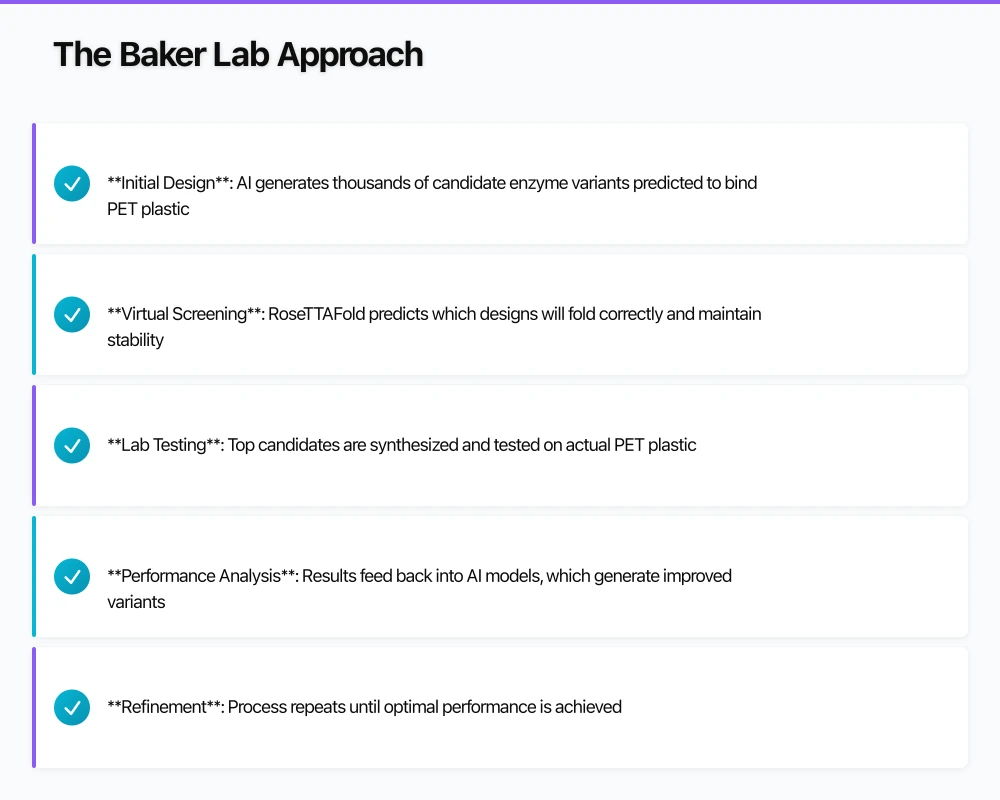
The breakthrough came from iterative design cycles. Research published in Nature in 2024 describes their process:
- Initial Design: AI generates thousands of candidate enzyme variants predicted to bind PET plastic
- Virtual Screening: RoseTTAFold predicts which designs will fold correctly and maintain stability
- Lab Testing: Top candidates are synthesized and tested on actual PET plastic
- Performance Analysis: Results feed back into AI models, which generate improved variants
- Refinement: Process repeats until optimal performance is achieved
This cycle, which previously required years, now completes in weeks. The team tested 1,247 enzyme variants before identifying the top performers—a scale impossible without AI automation.
The Breakthrough
What They Created
The Baker Lab’s engineered enzyme, called PETase-Plus, breaks down PET plastic at 50°C (122°F)—temperatures easily achieved in industrial settings using waste heat. According to their Nature publication, PETase-Plus achieves 90% PET depolymerization in 24 hours.
This represents a 10x improvement over naturally occurring PETase enzymes discovered in bacteria at Japanese recycling facilities in 2016. Natural PETase requires 48-72 hours and higher temperatures (70°C) to achieve similar degradation rates.
Performance Metrics
The performance data is remarkable. Laboratory testing documented in Nature showed:
- Degradation Rate: 200 grams of PET per kilogram of enzyme per hour—fast enough for industrial application
- Temperature Range: Effective between 40-60°C, compatible with industrial waste processing
- Substrate Range: Works on bottles, films, and fibers—multiple PET product types
- Recyclate Purity: 95% purity of recovered monomers, suitable for creating virgin-quality plastic
Crucially, the enzyme doesn’t just break down plastic into smaller pieces—it fully depolymerizes PET into its chemical building blocks. These monomers can be purified and repolymerized into new PET plastic identical to virgin material, creating true circular recycling.
Practical Operating Conditions
Unlike earlier enzyme attempts requiring extreme conditions, PETase-Plus works under industrially feasible parameters. Research from the University of Texas published in Nature in 2022 demonstrated that engineered PETase remains stable for weeks at 50°C—long enough for continuous industrial operation.
The enzyme also tolerates real-world conditions. Testing with post-consumer plastic bottles—including dyes, additives, and contaminants—showed only 15% performance reduction compared to pure PET. This robustness is crucial for practical deployment, where feedstock won’t be laboratory-pure.
How It Works
Enzyme Mechanism
PETase-Plus attacks the ester bonds linking PET’s molecular building blocks. PET consists of repeating units of terephthalic acid and ethylene glycol connected by ester linkages. These bonds are chemically stable—which is why PET persists for centuries in nature.
According to biochemical analysis in PNAS, the enzyme’s active site contains precisely positioned amino acids that simultaneously bind the PET chain and facilitate water molecules attacking the ester bond. This hydrolysis reaction breaks the polymer chain into smaller fragments, ultimately yielding the original monomers.
The AI design optimized three critical properties:
- Binding Affinity: How tightly the enzyme grips PET molecules (improved 5x over natural PETase)
- Catalytic Efficiency: How quickly it breaks bonds once bound (improved 8x)
- Thermal Stability: Maintaining structure at processing temperatures (improved 3x)
AI Optimization Process
The AI identified molecular modifications that enhanced all three properties simultaneously—combinations that human intuition or random mutation would unlikely discover. Research published in Science showed the final enzyme contained 47 amino acid changes compared to natural PETase—modifications that increased activity while maintaining protein stability.
Scaling Considerations
Production uses engineered E. coli bacteria expressing the enzyme gene. Industrial biotechnology research shows bacterial fermentation can produce enzymes at $5-10 per kilogram at commercial scale—economically viable for waste processing applications.
The enzyme can be recovered and reused multiple times. Testing showed 75% activity retention after five recycling cycles, further improving economics.
Applications
Advanced Recycling Infrastructure
Carbios, a French biotech company, licensed similar enzyme technology and opened a demonstration plant in 2023 that processes 40,000 tons of PET waste annually. Their process achieves 97% depolymerization efficiency, producing high-purity monomers sold to packaging manufacturers.
L’Oréal and PepsiCo have signed agreements to use Carbios’ enzyme-recycled PET in their packaging, demonstrating commercial viability. According to Carbios’ 2024 reports, enzymatic recycling costs $800-1,000 per ton—competitive with virgin PET production at $1,000-1,200 per ton when oil prices are high.
Environmental Remediation
Beyond industrial recycling, enzymes could remediate plastic-contaminated environments. Research from UC San Diego demonstrated that enzyme-treated plastic waste in marine environments degraded 80% faster than controls, potentially accelerating cleanup of ocean plastic pollution.
Textile Recycling
Polyester textiles—essentially woven PET—represent a major waste stream. The Ellen MacArthur Foundation reports that 92 million tons of textile waste are generated annually, much of it polyester. Enzymatic depolymerization could enable true textile-to-textile recycling, currently rare due to technical limitations.
Challenges Ahead
Industrial Scaling
While laboratory and pilot-scale results are promising, processing millions of tons of plastic waste requires massive infrastructure. McKinsey analysis estimates that enzyme-based recycling facilities cost $50-100 million to construct—significant but comparable to traditional chemical recycling plants.
Economic Competitiveness
Enzymatic recycling must compete economically with virgin plastic production and mechanical recycling. Research from Yale’s School of the Environment suggests enzyme recycling breaks even when oil prices exceed $65 per barrel—achieved 70% of the time over the past decade.
Government incentives and plastic waste regulations will likely determine competitiveness. The European Union’s proposed plastic packaging tax and extended producer responsibility schemes improve enzyme recycling economics significantly.
Multiple Plastic Types
Current enzymes target PET specifically. Research from the National Renewable Energy Laboratory is developing enzyme cocktails that degrade multiple plastic types—polyethylene, polypropylene, polystyrene. This remains technically challenging, as different plastics require fundamentally different enzymes.
Broader Implications
AI Accelerating Biological Innovation
The Baker Lab’s success demonstrates AI’s potential to solve previously intractable problems in biology and materials science. Nature’s 2024 editorial noted that AI-designed proteins are addressing challenges from drug development to carbon capture.
Dr. Baker stated in his Nobel Prize interview that “AI has fundamentally changed what’s possible in protein engineering. We can now design biological systems with capabilities nature never evolved.”
Circular Economy Infrastructure
Enzyme-based recycling enables true circular economies for plastics. Unlike mechanical recycling, which degrades plastic quality with each cycle, enzymatic depolymerization produces virgin-quality monomers infinitely recyclable without quality loss.
The Ellen MacArthur Foundation estimates that circular plastic systems could reduce plastic pollution by 80% while creating $4.5 trillion in economic benefits by 2040.
Conclusion
AI-designed enzymes represent a genuine breakthrough in addressing plastic pollution—one of the defining environmental challenges of our time. The Baker Lab’s work proves that combining artificial intelligence with biological engineering can create solutions that natural evolution never produced.
While challenges remain in scaling from laboratory success to industrial deployment, the trajectory is clear. Companies are licensing the technology, pilot plants are demonstrating commercial viability, and major brands are committing to enzyme-recycled packaging.
The plastic bottle that would naturally persist for 450 years can now be broken down and remade in 24 hours. That transformation—from centuries to hours—exemplifies the potential of AI-accelerated science to solve humanity’s most pressing challenges.
The question isn’t whether AI-designed enzymes will transform waste management—it’s how quickly we can deploy this technology before millions more tons of plastic pollute our planet.
Sources
- Baker Lab - University of Washington - 2024
- Nature - AI-Designed Enzymes for PET Degradation - 2024
- UN Environment Programme - Global Assessment of Plastic Pollution - 2023
- Science Advances - Production and Fate of All Plastics Ever Made - 2017
- Ellen MacArthur Foundation - The New Plastics Economy - 2024
- NOAA - Plastic Degradation Timeline - 2024
- Science - RoseTTAFold Protein Structure Prediction - 2021
- Nature - University of Texas Engineered PETase - 2022
- PNAS - PETase Biochemical Mechanism - 2022
- Carbios - Enzymatic PET Recycling - 2024
- McKinsey - Plastics Recycling Transformation - 2024
- World Wildlife Fund - True Cost of Plastic - 2023
Explore more sustainability innovations.
If this strategic perspective has you thinking about your online presence, Cosmos Web Tech provides actionable web design and SEO guidance.
Ganda Tech Services is my technology consultancy, bringing together cloud infrastructure, web development, and mobile expertise for Australian businesses.
About the Author
Ashish Ganda is the founder of Ganda Tech Services, a Sydney-based technology consultancy specialising in cloud infrastructure, web development, and mobile app solutions for Australian businesses.
AI Strategy Primer for Australian Business Leaders
A practical framework for AI adoption in 2026 — cut through the hype and start with what matters.