AI in Cybersecurity: The Essential Catalyst for Today's Businesses
Introduction
In 2023, a healthcare company’s security team faced 200,000 security alerts daily. Human analysts could investigate perhaps 10% of them. The other 180,000 alerts? Ignored—including the one that flagged ransomware encrypting patient records. By the time analysts noticed, attackers had locked 40,000 patient files and demanded $2 million.
After deploying AI-powered security, the same team now processes 99% of alerts automatically. Machine learning identifies the 0.3% of alerts representing real threats, escalating only 600 daily alerts to human analysts—all genuine security incidents. According to IBM’s Cost of a Data Breach Report 2024, organizations using AI and automation contain breaches 108 days faster than those without, reducing average breach costs from $4.88 million to $3.05 million.
Gartner predicts that by 2025, 40% of cybersecurity tasks will be automated using AI, up from 15% in 2022. AI hasn’t just become helpful for cybersecurity—it’s become essential for survival.
The Cybersecurity Challenge
Attack Volume Overwhelms Human Capacity
Research from Cybersecurity Ventures estimates global cybercrime costs reached $8 trillion in 2023 and will hit $10.5 trillion annually by 2025. The average organization faces 4,000-5,000 cyber attacks daily according to Check Point’s 2024 Security Report.
Human security analysts can’t scale to match this volume. The ISC2 Cybersecurity Workforce Study found a global shortage of 3.4 million cybersecurity professionals. Even well-staffed security operations centers face “alert fatigue”—so many alerts that critical threats get lost in noise.
Threats Evolve Faster Than Defenses
Traditional signature-based security recognizes known threats. But attackers constantly create new malware variants—over 450,000 new malicious programs detected daily according to AV-TEST Institute. By the time security vendors create signatures, attackers have moved to new variants.
Mandiant’s M-Trends Report 2024 found attackers now remain undetected in networks for an average of 16 days before discovery. Sixteen days to exfiltrate data, install backdoors, and prepare ransomware deployment—all while evading traditional defenses.
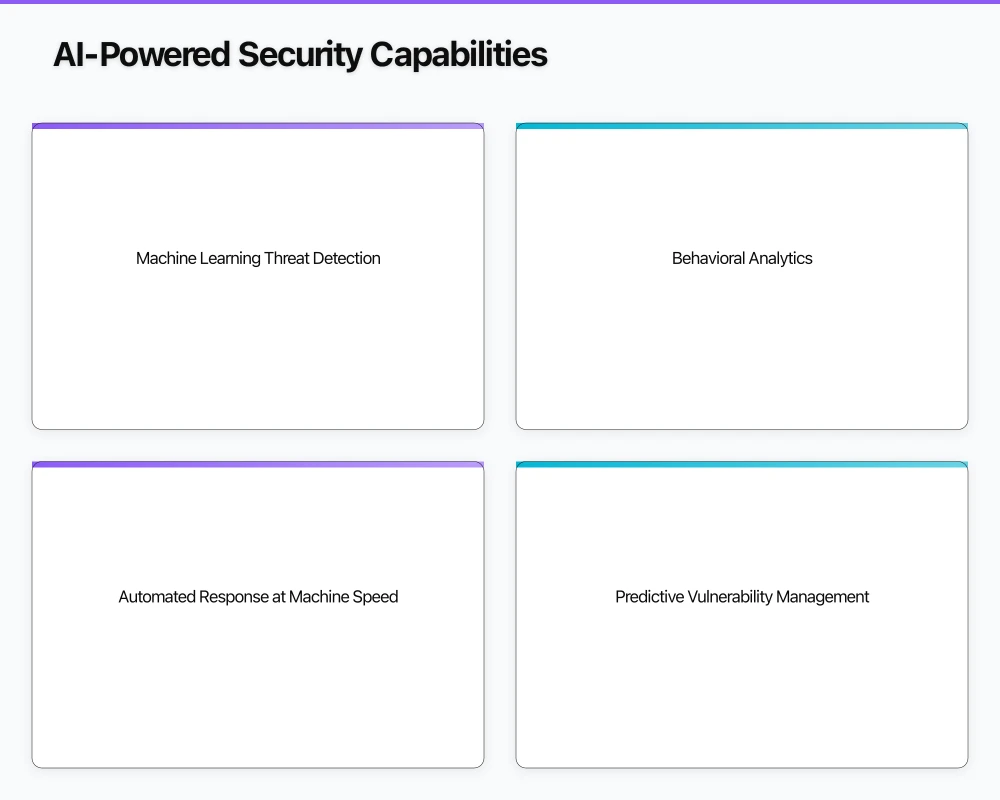
AI-Powered Security Capabilities
Machine Learning Threat Detection
AI systems analyze billions of events daily, identifying malicious patterns humans would never spot. Darktrace’s AI security platform, deployed at over 8,000 organizations, uses unsupervised machine learning to detect threats with zero prior knowledge. Their system identifies attacks by recognizing deviations from normal behavior rather than matching known signatures.
According to Darktrace’s 2024 threat report, their AI detected novel attacks 11 days before traditional signature-based systems—often the difference between containing an incident and suffering a major breach.
Behavioral Analytics
AI establishes behavioral baselines for every user, device, and system. When a CFO’s account suddenly accesses payroll databases at 3 AM or starts downloading gigabytes of customer data—behaviors completely out of character—AI flags this immediately.
Microsoft Sentinel, which uses AI for behavior analytics, analyzes 24 trillion security signals daily across Microsoft’s ecosystem. Microsoft’s security research shows behavioral AI reduces false positive alerts by 80% while catching 40% more real threats than rule-based systems.
Automated Response at Machine Speed
Attacks unfold in seconds. Ransomware can encrypt entire networks in under 5 minutes. Waiting for human analysts to investigate and respond ensures attackers succeed.
AI-powered endpoint detection and response (EDR) systems like CrowdStrike Falcon automatically isolate infected machines, kill malicious processes, and block command-and-control communications—all within milliseconds of detection. CrowdStrike’s data shows automated response contains threats in an average of 2 minutes versus 58 minutes for manual response.
Predictive Vulnerability Management
Organizations face thousands of security vulnerabilities in their software. But patching everything immediately is impossible—patches require testing and can break systems. Which vulnerabilities should you prioritize?
AI systems like Kenna Security analyze vulnerability characteristics, exploit availability, threat actor activity, and your specific environment to predict which vulnerabilities attackers will actually exploit. According to Kenna’s research, their AI prioritization helps organizations remediate 85% of critical risk by patching just 2-5% of vulnerabilities—versus traditional prioritization requiring 50% patch coverage for the same risk reduction.
Key Applications and Real-World Results
Network Traffic Analysis: Vectra AI uses AI to analyze network traffic patterns, detecting threats like data exfiltration, lateral movement, and command-and-control communications. Customers report detecting breaches 50-60% faster after deployment.
Email Security: Abnormal Security uses behavioral AI to detect phishing and business email compromise attacks that bypass traditional email filters. Their platform blocks 40% more attacks than signature-based systems according to independent testing.
Cloud Security: Wiz uses AI to analyze cloud configurations, identifying misconfigurations and vulnerabilities across AWS, Azure, and Google Cloud deployments. Organizations using Wiz reduce cloud security incidents by 70% on average.
Implementation Realities
Data Quality Determines Effectiveness
AI security systems learn from training data. Poor quality data produces poor detection. Research from MIT found that AI security systems trained on incomplete or biased data produce 30-50% more false positives and miss 20-35% of actual threats.
Organizations must feed AI systems comprehensive, representative data covering normal operations and attack patterns across their specific environment.
Integration Complexity
AI security tools must integrate with existing security infrastructure—firewalls, SIEM systems, identity management, endpoint protection. Forrester research found integration challenges delay AI security deployments by an average of 4-6 months.
Successful implementations prioritize API-based integrations and platforms designed for interoperability from day one.
Human Expertise Remains Critical
AI augments security teams but doesn’t replace them. Complex investigations, policy decisions, and strategic threat hunting still require human expertise. Gartner’s analysis emphasizes AI serves as a “force multiplier”—letting skilled analysts focus on high-value tasks rather than repetitive alert triage.
The AI Security Arms Race
Attackers use AI too. Malicious AI applications documented by DARPA include AI-generated phishing content, automated vulnerability discovery, and adaptive malware that modifies itself to evade detection.
This creates an arms race where both attackers and defenders leverage AI. Organizations without AI defenses face sophisticated AI-powered attacks with traditional tools—an impossibly unfair fight.
Conclusion
The healthcare company from our introduction demonstrates AI’s necessity. Before AI: overwhelmed by 200,000 daily alerts, missed critical threats, $2 million ransomware payment. After AI: automatically processing 99% of alerts, focusing analysts on genuine threats, containing incidents before they become breaches.
The 2024 Cybersecurity Workforce Study found organizations using AI security handle 5x more security events per analyst than those without. As attack volume continues growing while security talent remains scarce, AI transitions from competitive advantage to survival requirement.
The question isn’t whether to adopt AI cybersecurity—it’s how quickly you can deploy it before the next attack overwhelms your defenses.
Sources
- IBM - Cost of a Data Breach Report 2024 - 2024
- Gartner - Cybersecurity Predictions 2024 - 2024
- Check Point - Cyber Attack Statistics - 2024
- ISC2 - Cybersecurity Workforce Study - 2024
- Mandiant - M-Trends Report 2024 - 2024
- Darktrace - Threat Reports - 2024
- Microsoft Security - Research - 2024
- Forrester - Security Integration Challenges - 2024
Stay updated on cybersecurity trends and technologies.
Stay updated on cybersecurity trends and technologies.
For hands-on mobile development advice, visit Awesome Apps — our specialist app development blog for Australian businesses.
These insights are drawn from my work leading Ganda Tech Services — helping Australian businesses navigate digital transformation through cloud, web, and mobile.
About the Author
Ashish Ganda is the founder of Ganda Tech Services, a Sydney-based technology consultancy specialising in cloud infrastructure, web development, and mobile app solutions for Australian businesses.
AI Strategy Primer for Australian Business Leaders
A practical framework for AI adoption in 2026 — cut through the hype and start with what matters.