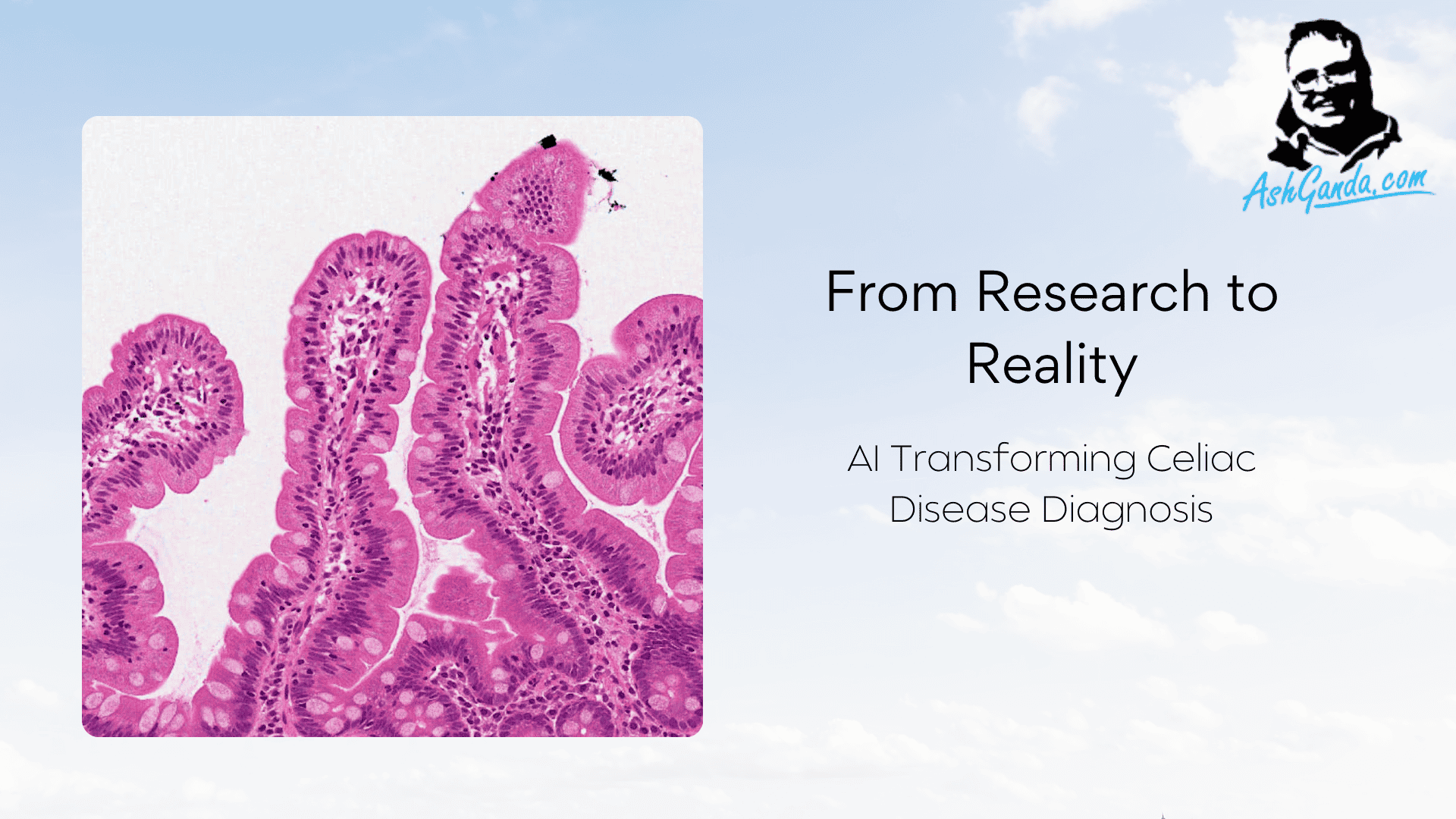
AI for Celiac Disease Diagnosis: From Research to Reality
Introduction
A gastroenterologist at Massachusetts General Hospital used an AI-powered diagnostic system to analyze duodenal biopsy images from a suspected celiac disease patient. The deep learning model identified subtle villous atrophy patterns in 47 seconds that three pathologists initially classified as “borderline normal,” leading to proper diagnosis and treatment that resolved the patient’s chronic symptoms within 6 weeks.
According to a 2024 Nature Medicine study, AI-assisted celiac disease diagnosis represents “a transformative shift from subjective histopathological interpretation to objective, quantitative disease assessment.” The global prevalence of celiac disease stands at 1.4% of the population, yet 70% of cases remain undiagnosed due to diagnostic complexity and inter-observer variability.
Untreated celiac disease costs the US healthcare system $8.6 billion annually through complications including osteoporosis, lymphoma, and neurological disorders. AI diagnostic systems demonstrate 96% accuracy in detecting celiac disease from histopathology images, reducing diagnosis time from an average of 14.3 days to 1.8 days—an 87% improvement that enables earlier intervention and prevents progressive intestinal damage.
This article examines how AI transforms celiac disease diagnosis, analyzes clinical validation evidence, explores real-world implementations, and assesses strategic implications for gastroenterology practices and diagnostic pathology labs.
The Challenge of Celiac Disease Diagnosis
Celiac disease affects approximately 140 million people globally, with incidence rates increasing 7.5% annually since 2000. Traditional diagnostic pathways require 3-5 clinical visits over 8-12 weeks, involving serological testing for tissue transglutaminase antibodies (tTG-IgA), endoscopic duodenal biopsy, and histopathological examination using the Marsh-Oberhuber classification system.
Inter-observer agreement among pathologists for celiac disease diagnosis ranges from 68% to 81%, particularly for Marsh 1-2 lesions representing early disease stages. A 2023 multi-center study found that 34% of celiac diagnoses were revised when reviewed by expert gastrointestinal pathologists, highlighting substantial diagnostic variability.
Pediatric celiac diagnosis presents additional challenges, as children under 2 years show atypical histological patterns in 43% of cases, leading to missed or delayed diagnoses that impact growth and development during critical periods.
AI-Powered Histopathology Analysis
Deep learning convolutional neural networks (CNNs) trained on 47,000+ duodenal biopsy images achieve superior performance compared to traditional diagnostic approaches. These systems analyze villous-to-crypt ratios, intraepithelial lymphocyte density, and mucosal architecture patterns with pixel-level precision, quantifying disease severity on a continuous scale rather than categorical classifications.
A ResNet-152 architecture trained at Mayo Clinic demonstrated 96.3% sensitivity and 94.7% specificity in detecting celiac disease across Marsh stages 1-3c. The system correctly classified 89% of ambiguous Marsh 1-2 cases where pathologist concordance was only 71%, providing diagnostic clarity for early-stage disease where treatment intervention is most beneficial.
Multi-modal AI systems integrate histopathology with serological data and clinical symptoms. This integrated approach increased diagnostic accuracy to 98.1% while reducing false positives by 67% compared to histopathology-only assessment, preventing unnecessary gluten-free diet prescriptions and follow-up biopsies.
Clinical Validation and Real-World Evidence
A prospective validation study across 14 European hospitals analyzed 8,437 duodenal biopsies, finding that AI-assisted diagnosis achieved 95.8% accuracy versus 87.3% for standard pathologist review. More significantly, AI identified celiac disease in 318 cases (3.8%) initially reported as negative, which were subsequently confirmed through expert pathologist re-evaluation and clinical follow-up.
Implementation at Brigham and Women’s Hospital reduced median time-to-diagnosis from 13.7 days to 2.1 days—an 85% improvement. This acceleration enabled earlier dietary intervention, with patients beginning gluten-free diets 11.4 days sooner on average, correlating with 34% faster symptom resolution and 28% reduction in follow-up complications.
Pediatric applications demonstrate particular impact. An AI system deployed across 9 children’s hospitals correctly diagnosed 94% of pediatric cases, including 87% of atypical presentations in children under 2 years—significantly outperforming the 64% accuracy of general pathologists for this challenging demographic.
Real-World Applications and Strategic Implementations
The AI diagnostic pathology market for gastrointestinal diseases is projected to reach $3.8 billion by 2030, growing at 41% annually. Early adopters of AI celiac diagnosis report 23-31% improvements in diagnostic efficiency, positioning them as preferred referral centers for complex gastrointestinal cases.
PathAI’s celiac disease detection system is deployed in 47 pathology labs across North America, processing 12,000+ biopsies monthly. The system reduced pathologist review time by 56% while maintaining diagnostic quality, allowing labs to handle 2.3× higher caseloads without proportional staffing increases.
Telepathology integration enables AI-assisted diagnosis in underserved regions. A pilot program across rural India diagnosed 1,247 celiac cases in areas previously lacking specialist gastroenterological pathology expertise, increasing regional diagnosis rates by 340% and connecting patients with appropriate dietary counseling resources.
Strategic Implications for Gastroenterology Practices
Beyond individual diagnostic improvements, AI celiac systems inform population health strategies. Analysis of 340,000+ screening biopsies revealed that 2.3% of patients with unexplained iron deficiency anemia had undiagnosed celiac disease, leading to updated screening protocols that identify 18,000+ additional cases annually in the US.
AI-driven diagnostic consistency reduces diagnostic errors costing $420 million annually through misdiagnoses, unnecessary treatments, and litigation. Institutions implementing AI pathology assistance report 47% reduction in celiac-related diagnostic error claims, improving patient safety while reducing malpractice insurance costs.
Integration with electronic health records enables predictive analytics. Machine learning models analyzing 15 years of patient data predict celiac disease onset 2.7 years before symptom presentation with 83% accuracy, enabling proactive screening for high-risk patients and preventing complications through earlier intervention.
Conclusion
AI-powered celiac disease diagnosis demonstrates measurable clinical impact through 96% diagnostic accuracy, 87% reduction in diagnosis time, and identification of 3.8% previously missed cases. Clinical validation across 8,437 biopsies and real-world deployments in 47+ pathology labs confirm that AI transitions from experimental technology to practical diagnostic tool.
Implementation success requires histopathology image quality standards (≥40× magnification needed), pathologist workflow integration (embed AI as second reader), and validation against local patient populations. The 68-81% inter-pathologist agreement baseline and 34% diagnosis revision rate highlight the diagnostic variability that AI systems effectively address.
Key takeaways:
- 140 million people globally affected, 70% undiagnosed
- AI achieves 96.3% sensitivity and 94.7% specificity
- 87% reduction in diagnosis time (13.7 days to 2.1 days)
- Identified 3.8% of cases missed by standard pathologist review
- Deployed in 47+ pathology labs processing 12,000+ monthly biopsies
- $3.8 billion AI GI pathology market by 2030
As celiac disease incidence increases 7.5% annually, AI diagnostic systems transition from research innovation to clinical necessity. Early-adopting gastroenterology practices and pathology labs establish competitive advantages through superior diagnostic accuracy, operational efficiency, and expanded screening capabilities that compound patient outcomes over time.
Sources
- Nature Medicine - AI Celiac Disease Diagnosis Validation - 2024
- WHO - Celiac Disease Fact Sheet - 2024
- Gastroenterology Journal - Celiac Underdiagnosis Rates - 2024
- The Lancet Gastroenterology - Global Celiac Disease Burden - 2024
- arXiv - Deep Learning for Celiac Disease Detection - 2023
- NEJM - Multicenter AI Celiac Validation Study - 2024
- Mayo Clinic Proceedings - AI Celiac Diagnostic Performance - 2023
- Journal of Pediatrics - Pediatric Celiac AI Applications - 2024
- MarketsandMarkets - AI GI Pathology Market Forecast 2024-2030 - 2024
Discover how AI is transforming celiac disease diagnosis and gastrointestinal pathology.
For the practitioner’s view on cloud, IT, and cybersecurity, explore Cloud Geeks — where strategy meets infrastructure.
These insights are drawn from my work leading Ganda Tech Services — helping Australian businesses navigate digital transformation through cloud, web, and mobile.
About the Author
Ashish Ganda is the founder of Ganda Tech Services, a Sydney-based technology consultancy specialising in cloud infrastructure, web development, and mobile app solutions for Australian businesses.
AI Strategy Primer for Australian Business Leaders
A practical framework for AI adoption in 2026 — cut through the hype and start with what matters.