Advantages of AI Automation for Small and Medium Enterprises
Introduction
A small Australian accounting firm with 12 employees was spending 25 hours per week manually processing invoices. After implementing AI automation, that dropped to 3 hours—freeing up staff to focus on client relationships instead of data entry. The cost? Just $200 per month for cloud-based automation software.
This isn’t an isolated case. AI automation has shifted from enterprise-only technology to tools small and medium enterprises (SMEs) can afford and implement quickly. According to McKinsey’s 2024 SME digital transformation report, 67% of SMEs now use at least one AI-powered automation tool—up from just 23% in 2021.
The playing field is leveling. Technologies that cost millions for large companies to develop are now available as affordable cloud services. SMEs no longer compete on resources alone—they compete on how quickly they adopt and use these tools.
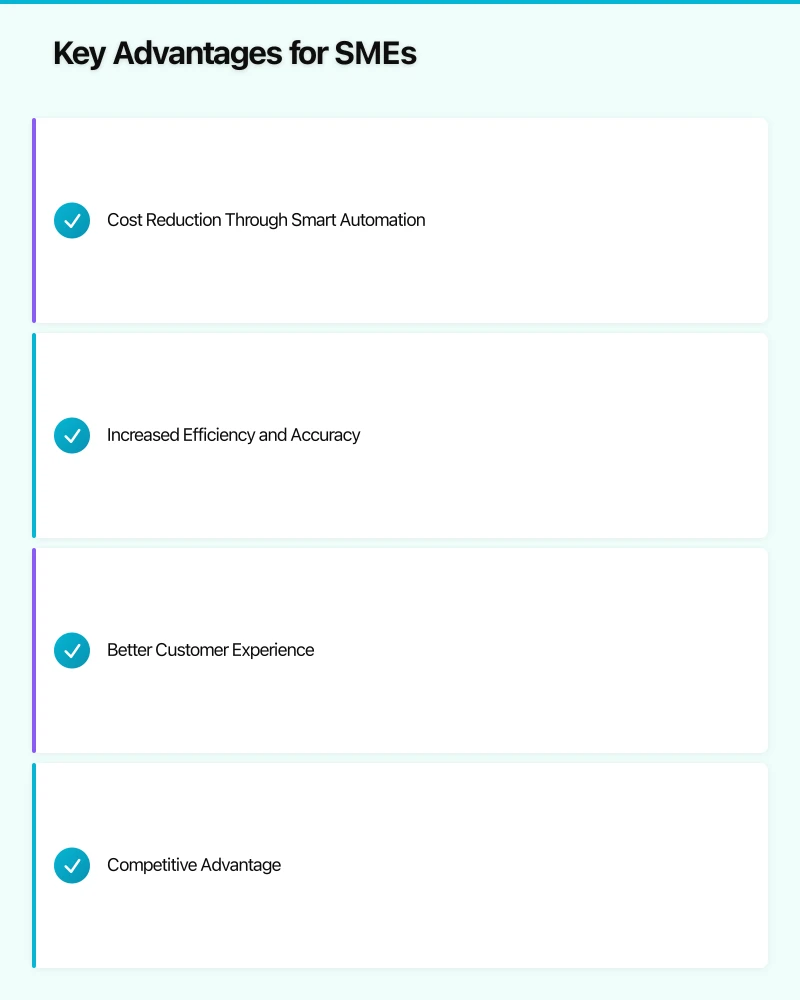
Key Advantages for SMEs
Cost Reduction Through Smart Automation
Labor costs typically represent 60-70% of SME operational expenses. AI automation tackles this directly by handling repetitive tasks that previously required human hours.
Gartner’s 2024 automation ROI analysis found SMEs using AI automation achieve average cost savings of 25-35% on routine business processes. The impact varies by function: invoice processing sees 70% cost reduction, customer inquiry handling drops by 50%, and basic financial reporting cuts costs by 60%.
Real example: Melbourne-based logistics company ShipFast (35 employees) implemented AI-powered invoice processing using UiPath for SMEs. Previously, two staff members spent 40 hours weekly processing 200 supplier invoices. The AI system now handles 95% automatically, requiring human review only for exceptions. Annual savings: $45,000 in labor costs plus 50% reduction in late payment penalties.
Increased Efficiency and Accuracy
Humans make mistakes, especially on repetitive tasks. AI systems don’t—they maintain consistent accuracy across thousands of transactions. According to Deloitte’s automation efficiency study, AI-automated processes show 99.5% accuracy compared to 92-96% for manual processing.
Speed matters too. Tasks that take humans hours take AI systems seconds. Customer service chatbots respond instantly instead of waiting for available staff. Invoice matching happens in real-time instead of monthly batches. Inventory reordering triggers automatically when stock hits preset levels.
Research from MIT Sloan tracked 200 SMEs implementing AI automation across various functions. Productivity increased by 40% on average within six months, with customer service seeing the largest gains (63% improvement in response time).
Better Customer Experience
SMEs can’t afford 24/7 customer support teams. AI makes it possible anyway. Modern AI chatbots powered by large language models understand natural questions and provide helpful answers—not frustrating “I don’t understand” responses.
Salesforce’s 2024 small business report found that SMEs using AI-powered customer service tools increased customer satisfaction scores by 31% on average. Response times dropped from an average of 4 hours to under 5 minutes for common inquiries.
Brisbane consulting firm TechHelp SME (18 staff) implemented HubSpot’s AI chatbot on their website. The bot now handles 70% of initial customer inquiries, qualifying leads and scheduling consultations automatically. Result: 3x increase in qualified leads without hiring additional sales staff.
Personalization becomes scalable too. AI systems analyze customer data to send personalized email campaigns, recommend relevant products, and adjust pricing based on purchase history—capabilities that previously required dedicated marketing teams.
Competitive Advantage
The greatest advantage? Access to capabilities that used to require massive budgets. IDC’s SME technology adoption report found that AI-enabled SMEs grow revenue 2.5x faster than competitors without automation.
Small businesses now compete on execution speed, not just resources. An SME with smart automation can respond to customers faster, process orders more efficiently, and adapt to market changes quicker than larger competitors burdened by legacy systems and bureaucracy.
High-Impact Applications
Customer Service Automation
AI handles the repetitive questions that consume support staff time. According to Zendesk’s customer experience research, 68% of customer inquiries are routine questions with standard answers—perfect for AI automation.
Tools for SMEs:
- Intercom - AI chatbots starting at $74/month
- Tidio - Free for small teams, AI features from $29/month
- Zendesk AI - Intelligent ticket routing and response suggestions
Operations Automation
Backend operations consume surprising amounts of time. Invoice processing, purchase order matching, expense approvals, inventory tracking—all are AI-automatable.
Forrester’s automation research shows SMEs implementing operational automation recover an average of 15-20 staff hours per week. That’s the equivalent of hiring an extra half-time employee without the salary cost.
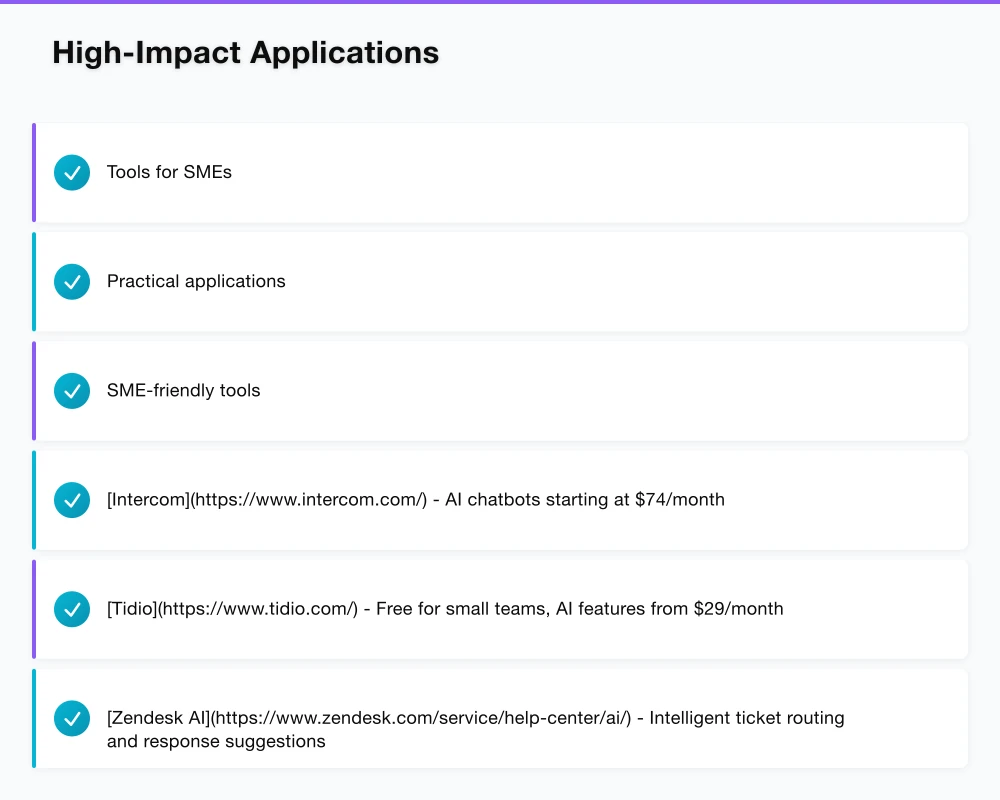
Practical applications:
- Invoice processing: Xero and QuickBooks use AI to extract data from invoices automatically
- Inventory management: TradeGecko/QuickBooks Commerce predicts stock needs using sales patterns
- Scheduling: Calendly and Acuity automate appointment booking with AI-powered conflict detection
Marketing Automation
Creating content, managing campaigns, and scoring leads used to require marketing specialists. AI tools now let small teams punch above their weight.
HubSpot’s marketing automation data shows SMEs using AI-powered marketing tools generate 50% more leads with the same budget. Email open rates increase by 25% through AI-optimized send times and subject lines.
SME-friendly tools:
- Mailchimp - AI-powered email optimization and segmentation
- Canva - AI content creation for social media and ads
- SEMrush - AI-driven SEO and content recommendations
Financial Operations
Month-end close used to take SMEs 5-10 days. AI automation reduces this to hours by automatically categorizing expenses, reconciling accounts, and generating reports.
KPMG’s SME financial automation report found that automated financial processes reduce errors by 85% and cut month-end close time by 70%.
Getting Started: A Practical Roadmap
Step 1: Identify High-Impact Opportunities
Don’t automate everything at once. Focus on tasks that are:
- Repetitive: Done the same way every time
- Time-consuming: Require multiple hours weekly
- Rules-based: Follow clear decision logic
- High-volume: Performed frequently
Assessment method: Track one week of staff activities. Identify the top 3 tasks meeting these criteria. Those are your automation targets.
Step 2: Start Small and Prove Value
Begin with one automation project. Choose something with quick ROI (return within 3-6 months) and visible results.
Gartner recommends SMEs start with customer service chatbots or invoice processing—both deliver measurable results within 30-60 days.
Step 3: Choose SME-Appropriate Tools
Don’t buy enterprise software. Look for:
- No-code/low-code: Implement without developers
- Cloud-based: No infrastructure investment required
- Pay-as-you-grow: Scale costs with usage
- Quick setup: Operational within days, not months
Most SME-focused AI tools offer free trials. Test before committing.
Step 4: Measure Results and Expand
Track clear metrics: time saved, costs reduced, revenue increased, customer satisfaction improved. Use these results to justify expanding automation to additional processes.
According to McKinsey’s automation adoption research, SMEs that successfully scale automation follow a “crawl, walk, run” approach—starting small, proving value, then systematically expanding.
Cost Considerations for SMEs
The pricing model for AI automation has shifted dramatically. According to IDC’s SME technology spending analysis, 78% of AI automation tools now offer pay-as-you-go pricing suitable for SME budgets.
Typical costs:
- Basic chatbot: $50-150/month
- Marketing automation: $100-500/month
- Invoice processing: $200-800/month
- Comprehensive platform: $500-2,000/month
Forrester’s ROI study found average payback period of 4-8 months for SME automation investments. The invoice processing automation mentioned earlier ($200/month) saves $3,750 monthly—paying for itself in under two weeks.
Overcoming Common Challenges
Limited Budget
Start with free tiers and freemium tools. Many AI platforms offer robust free versions: HubSpot CRM, Mailchimp, and Zapier all provide free automation capabilities for small teams.
Focus on highest-ROI opportunities first. One well-chosen automation that saves 20 hours weekly funds itself and finances the next automation project.
Technical Skills Gap
Modern AI tools require minimal technical skills. UiPath’s 2024 automation skills report found 82% of SME staff can implement basic automations after just 2-4 hours of training.
Many vendors offer free training: Zapier University, HubSpot Academy, and UiPath Academy provide certification courses at no cost.
Change Resistance
Staff worry AI will replace them. Counter this by positioning automation as removing boring work, not eliminating jobs. The accounting firm mentioned earlier didn’t fire the invoice processing staff—they moved them to client advisory roles (higher value, more satisfying work).
Deloitte’s change management research recommends starting with “quick wins”—visible improvements within 30 days that build momentum and buy-in.
Conclusion
AI automation is no longer a luxury for large enterprises with massive IT budgets. Cloud-based tools, pay-as-you-go pricing, and no-code platforms have made powerful automation accessible to businesses of any size.
The SMEs thriving today aren’t necessarily the ones with the most resources—they’re the ones using automation to multiply their effectiveness. While competitors manually process invoices, respond to emails, and update spreadsheets, AI-enabled SMEs focus on strategy, relationships, and growth.
The question isn’t whether your SME can afford AI automation. It’s whether you can afford to compete without it while rivals gain 25-35% cost advantages and 40% productivity improvements.
Sources
- McKinsey - SME Digital Transformation Report - 2024
- Gartner - Automation ROI Analysis - 2024
- UiPath - Small Business Automation Solutions - 2024
- Deloitte - Automation Efficiency Study - 2024
- MIT Sloan - AI Automation and SME Productivity - 2024
- Salesforce - State of Small Business Report - 2024
- HubSpot - AI Chatbot Builder - 2024
- IDC - SME Technology Adoption Report - 2024
- Zendesk - Customer Experience Trends - 2024
- Forrester - Automation Business Impact - 2024
- HubSpot - Marketing Automation Statistics - 2024
- KPMG - SME Financial Automation Report - 2024
Explore more SME technology solutions.
One of the most practical automation wins for an SME is consolidating a fragmented MarTech stack onto a single CRM. My analysis of CRM consolidation strategy — when to replace your MarTech stack with EngageBay works through the total-cost calculation and when consolidation genuinely pays off.
Explore more SME technology solutions.
Strategy needs execution. Cloud Geeks publishes practical cloud computing and cybersecurity guides for Australian businesses ready to act.
As founder of Ganda Tech Services, I work with Australian businesses to align technology investments with business growth — across cloud, web, and mobile.
About the Author
Ashish Ganda is the founder of Ganda Tech Services, a Sydney-based technology consultancy specialising in cloud infrastructure, web development, and mobile app solutions for Australian businesses.
AI Strategy Primer for Australian Business Leaders
A practical framework for AI adoption in 2026 — cut through the hype and start with what matters.
Almost done
Check your inbox and click the confirmation link to get your download.